

Diplomatique medallion: the Watchman's Belt over a compass rose and sword
Diplomatique™
✦

Intelligence · Perspective · Distinction

MMXXVI · Q4 · NO. 3 · 22 OCTOBER 2026

Jockeying for Position

The Race Before the Race

The midterms are nearly upon us. The contest for the White House in 2028 is already taking shape.

The Art of Political Mischief — Marco Rubio and JD Vance at the Oval Office door, original watercolour by Brian John Spencer
Brian John Spencer, 19 October 2026. Original watercolour. Courtesy of the artist.

Lens · Across Diplomatique™’s Six Lenses

IUnderstanding the Times™

Jockeying for Position

The Race Before the Race

Mark J. Finlay | Editor

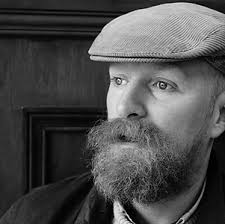
Mark J. Finlay, watercolour caricature by Brian John Spencer
Mark J. Finlay, as seen by Brian John Spencer. Original watercolour caricature, 14 March 2019.

Two men. One doorway. And a rather perceptive artist.

On our cover, Belfast artist Brian John Spencer imagines Vice President JD Vance and Secretary of State Marco Rubio attempting to pass through the same doorway into the Oval Office. Both wear red ties. Both appear determined to get there. Neither seems particularly inclined to give way.

The artist has captured something that political commentators can spend entire evenings trying to explain.

The race before the race has begun.

Not officially, of course. The presidential field for 2028 has not been settled, and Americans have yet to cast their ballots in the 2026 midterms. But politics abhors a vacuum, and the question of what comes after President Trump's second term is already part of the conversation.

On 3 November, Americans will elect a new House of Representatives and determine the balance of power in the Senate. The consequences will extend far beyond Capitol Hill.

The outcome will help determine the legislative prospects of President Trump's administration during its remaining two years. It will influence the direction of both major parties, the emergence of new political leaders, and the circumstances in which the next presidential contest unfolds.

For Republicans, questions of succession and continuity are already intertwined. For Democrats, the midterms offer an opportunity to contest control of Congress while testing the political arguments and personalities that may shape their next presidential campaign.

We have deliberately chosen to examine the Runners & Riders before the midterms, not afterwards. Alongside them, we consider the congressional Races to Watch, where money, momentum, local loyalties and national issues are converging.

The starting gates are open. The field is far from settled.

But this edition is about considerably more than American elections.

Events, dear boy, events.

Even as we prepared these pages for publication, developments continued to challenge the assumptions upon which governments, businesses and investors make their decisions.

In Britain, the Labour government's approval of the Jackdaw North Sea gas development has brought the competing demands of energy security, economic necessity and climate commitments into sharp relief. The decision belongs within a much larger conversation about the strategic importance of the North Atlantic, its resources and the industrial capacity of the nations bordering it.

Diplomatic efforts involving Washington and Moscow offer another reminder that negotiations do not occur in isolation from the realities of military power, geography and national interest. A meeting may open a door. It cannot, by itself, establish the confidence necessary for a durable peace.

Meanwhile, Saudi Arabia's postponement of the tenth Future Investment Initiative illustrates how geopolitical uncertainty can reach into the calendar of international finance. Even the places where global capital traditionally gathers are not insulated from events.

These are not disconnected stories.

They illuminate the relationship between political decisions, strategic geography and the confidence upon which commerce, investment and international relationships depend.

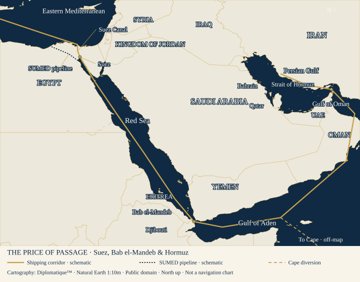
That is also the proposition behind Where the World Narrows™. The great maritime passages of the world are not merely lines on a shipping chart. They are places where geography concentrates power, where the freedom of commerce encounters the realities of security, and where seemingly distant events acquire immediate economic consequences.

In The Skies Above, we turn to Britain's place in the defence of the North Atlantic, from RAF Lossiemouth and its Poseidon maritime patrol aircraft to the Greenland–Iceland–UK Gap. Here, too, geography shapes the choices available to governments and their allies.

The world does not organize itself around electoral cycles. Nor does it wait for political leaders to finish jockeying for position.

Power and Confidence

There is a thread running through each of these stories: the relationship between political power and confidence.

The American midterms will test public confidence in the country's political direction. In Britain, the competing demands of energy security, economic necessity and climate commitment are testing confidence in government. At the world's maritime chokepoints, insecurity challenges confidence in the freedom of trade. And in the skies above Britain, credible defence helps sustain confidence that allies can protect what they have pledged to defend.

Even the institutions of civil society face the same test. As we explore in our examination of corporate repentance and redemption, confidence lost through failures of leadership cannot simply be demanded back. It must be earned through accountability and reform.

Power can command attention. It can sometimes compel obedience. But lasting leadership requires something more: confidence that is deserved, commitments that are kept, and institutions worthy of the trust placed in them.

That is a question we shall return to in future editions of Diplomatique™.

Amid these serious questions, there is also room for wit.

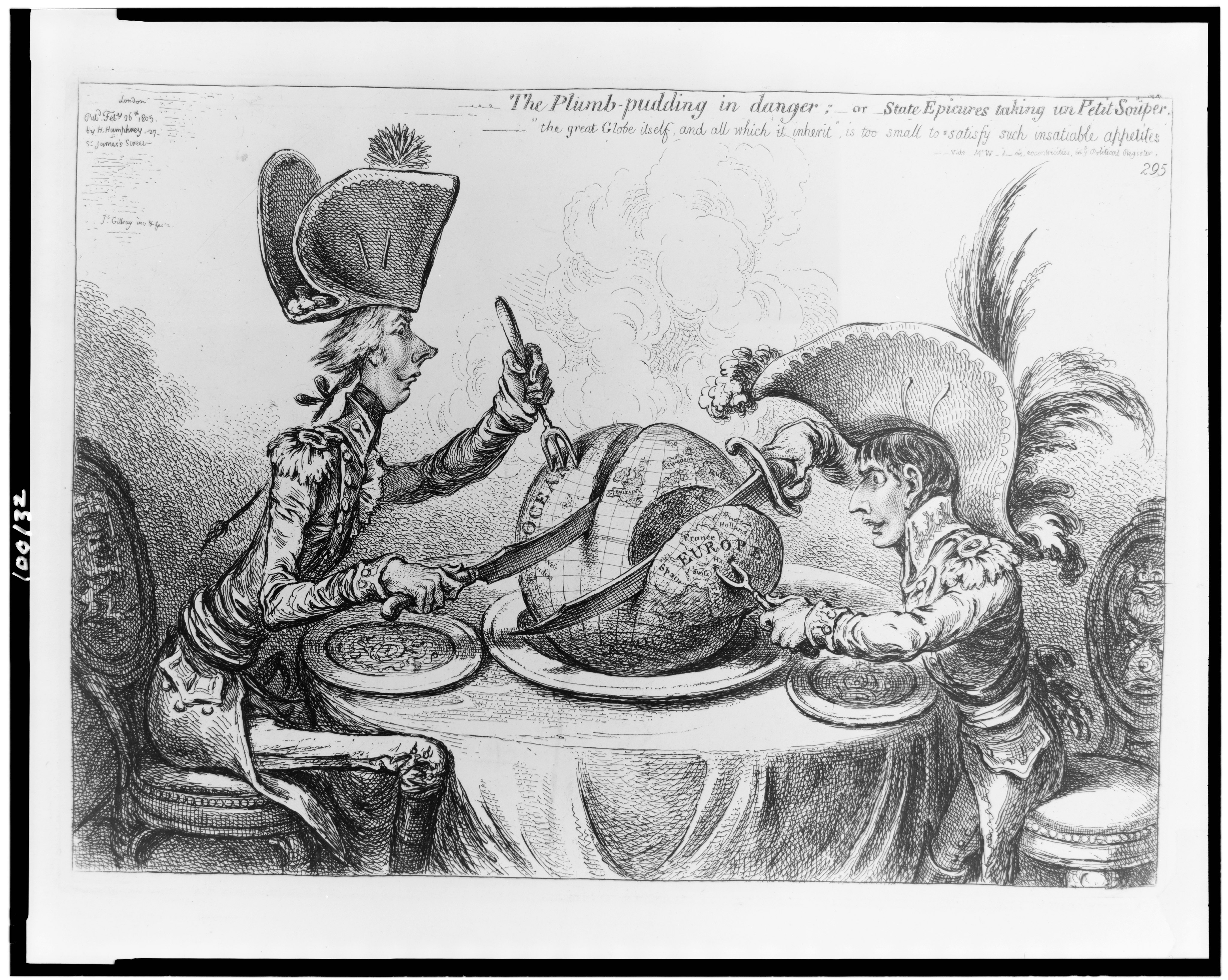
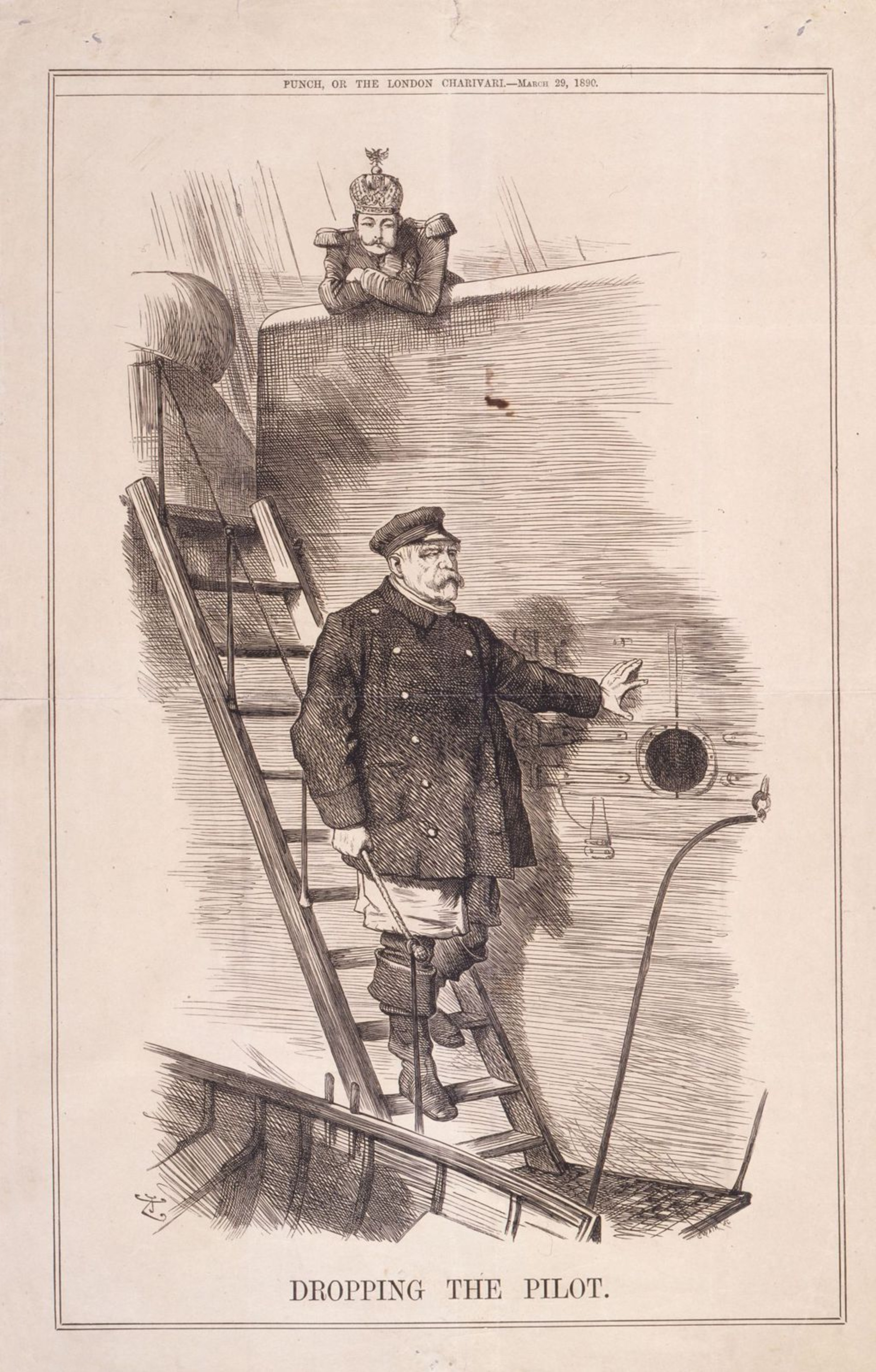
Our feature The Art of Political Mischief traces the history of political caricature from Hogarth and Gillray through Punch to the present day. For centuries, artists have reminded kings, prime ministers, presidents and would-be presidents that power does not confer immunity from ridicule.

Brian John Spencer continues that tradition with a smile and a paintbrush.

Yet beneath the humour lies a more serious observation.

Political life is full of people seeking to get through doors — into office, into negotiations, into markets, into alliances and occasionally into history itself.

Some doors open through elections. Others through diplomacy, commerce or the patient work of building confidence. Still others remain closed, sometimes at considerable cost.

The challenge is not merely to be first through the doorway, but to understand what lies beyond it.

The race is taking shape. The world is not standing still.

Welcome to Diplomatique™ No. 3.

Understanding the Times.

Continue to Runners & Riders →

Lens · Power & Statecraft

IIThe Runners & Riders

The Runners & Riders

Two Parties. Many Ambitions. And an Unsettled Middle Ground.

The race for the White House in 2028 has yet to be formally joined. But the jockeying has already begun. As Americans prepare for the November 3 midterms, Diplomatique™ takes an early look at the men and women who may seek the presidency, the forces shaping their prospects, and the political territory between the two major parties.

Mark J. Finlay | Editor · No. 3 · 22 October 2026
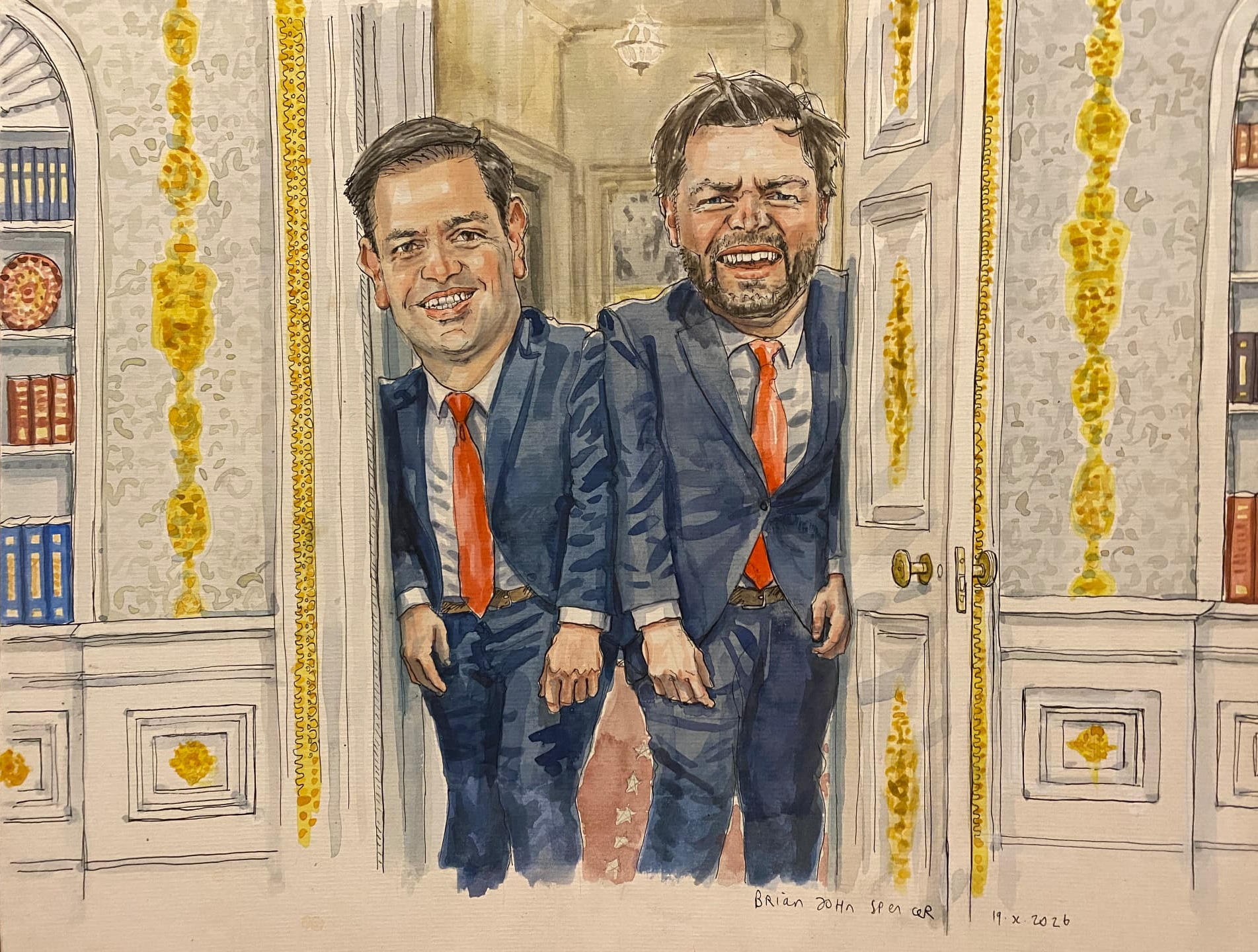
Marco Rubio and JD Vance attempting to pass through the Oval Office doorway, original watercolour by Brian John Spencer
Brian John Spencer, 19 October 2026. Original watercolour. Courtesy of the artist.

Editorial proof · Supporting evidence and plates under review

Open the feature separately ↗

The Race Before the Race

In less than two weeks, Americans will go to the polls to elect a new House of Representatives, determine control of the Senate and settle important contests for governor and other state offices.

But we have chosen, quite deliberately, to look beyond November 3.

Why examine the presidential field before the midterms, rather than wait for the results?

Because the outcome of those elections will inevitably change the political calculations for 2028. Some prospective contenders will emerge strengthened, others weakened. New names may enter the conversation. Fundraising, endorsements, alliances and ambitions will shift accordingly.

We want to establish the field before that happens.

Nobody among the principal prospective contenders discussed here has formally declared a candidacy for the 2028 presidency in the reporting considered for this article. No party has selected its nominee. Indeed, some of the individuals we examine may never become candidates at all.

Yet political ambitions rarely begin with formal announcements.

They emerge through speeches, travel, fundraising, relationships, carefully chosen interventions and the cultivation of constituencies far beyond a politician's present office.

On the Republican side, the central question is who might inherit President Trump's political movement—and whether that inheritance would be sufficient to win a national election.

For the Democrats, the challenge is rather different: identifying a candidate capable of uniting a fragmented party while winning back voters who have drifted away from it.

And between them lies an unsettled political middle ground, occupied by millions of Americans who may feel increasingly poorly served by either party.

It is here, too, that we consider the potential significance of former South Carolina Governor David Beasley—a man whose international experience, Christian faith and relationships across political divides make him an intriguing figure, even if his path to the presidency is far from evident.

This is not a prediction of who will win in 2028. It is an examination of who may run, why they might matter, and how the political arithmetic could change.

The runners and riders are assembling.

The starting gate remains some distance away.

I. The Republicans

Who Inherits MAGA?

The Republican starting gate is not yet occupied. But two prospective contenders have already established a substantial presence in the early political conversation.

Vice President JD Vance and Secretary of State Marco Rubio.

Both serve at the heart of President Trump's administration. Both enjoy considerable national recognition. Both have access to political relationships and resources that would be the envy of most prospective presidential candidates.

Yet they represent rather different political propositions.

President Trump is constitutionally barred from seeking another elected presidential term. That does not mean his influence will diminish as the succession contest approaches.

Quite the opposite.

The president remains the dominant personality within the Republican Party. His preferences, endorsements and judgments could exert enormous influence over the eventual nomination.

But there is a fundamental distinction between inheriting the loyalty of President Trump's supporters and persuading the wider American electorate to elect his successor.

The candidate best equipped to win the Republican nomination may not necessarily be the candidate best equipped to win the presidency.

That is the central calculation confronting the party.

JD Vance — The Early Favourite
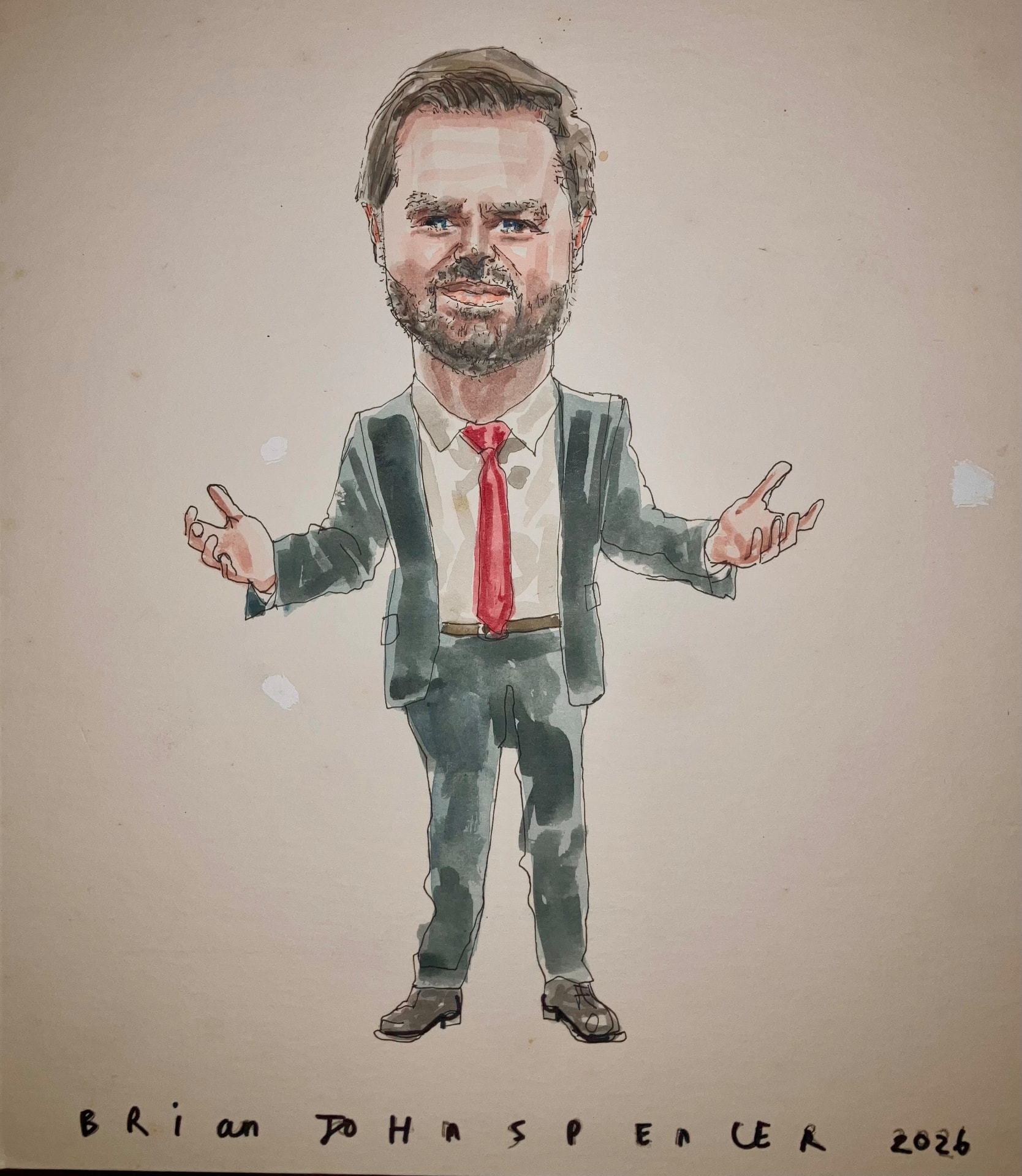
JD Vance, original watercolour caricature by Brian John Spencer
JD Vance. Brian John Spencer, 2026. Original watercolour. Courtesy of the artist.

Vice President Vance begins with the institutional advantages of the office he holds.

He is the sitting vice president, closely identified with President Trump's political movement, and an increasingly prominent figure in both domestic and foreign policy.

His journey from a troubled childhood in Ohio to the United States Senate and then the vice presidency is a compelling American story.

His bestselling memoir, Hillbilly Elegy, introduced him to a national audience well before he entered electoral politics. It also established his credentials as an interpreter of the social and economic dislocation experienced by communities that had once been central to American manufacturing.

Vance understands the grievances that helped carry President Trump to the White House. He has also developed an intellectual and political framework around questions of industrial policy, economic nationalism, immigration and America's international commitments.

His early prominence is measurable.

Republican presidential preference polling in early October placed Vance ahead of the other prospective contenders.

But polling conducted two years before a presidential election is not a reliable prediction of the eventual result. It measures recognition, enthusiasm and present preferences among a field that may change considerably.

Vance's challenge will include distinguishing himself from the administration he serves.

He will have to demonstrate that he offers not merely continuity but a credible programme for the next decade.

He must also address the consequences of decisions made during President Trump's second term, including those in which he has had a prominent role.

The vice presidency provides an excellent vantage point from which to approach the starting gate.

It does not guarantee a successful finish.

Marco Rubio — The Statesman, the Orator and the Acropolis
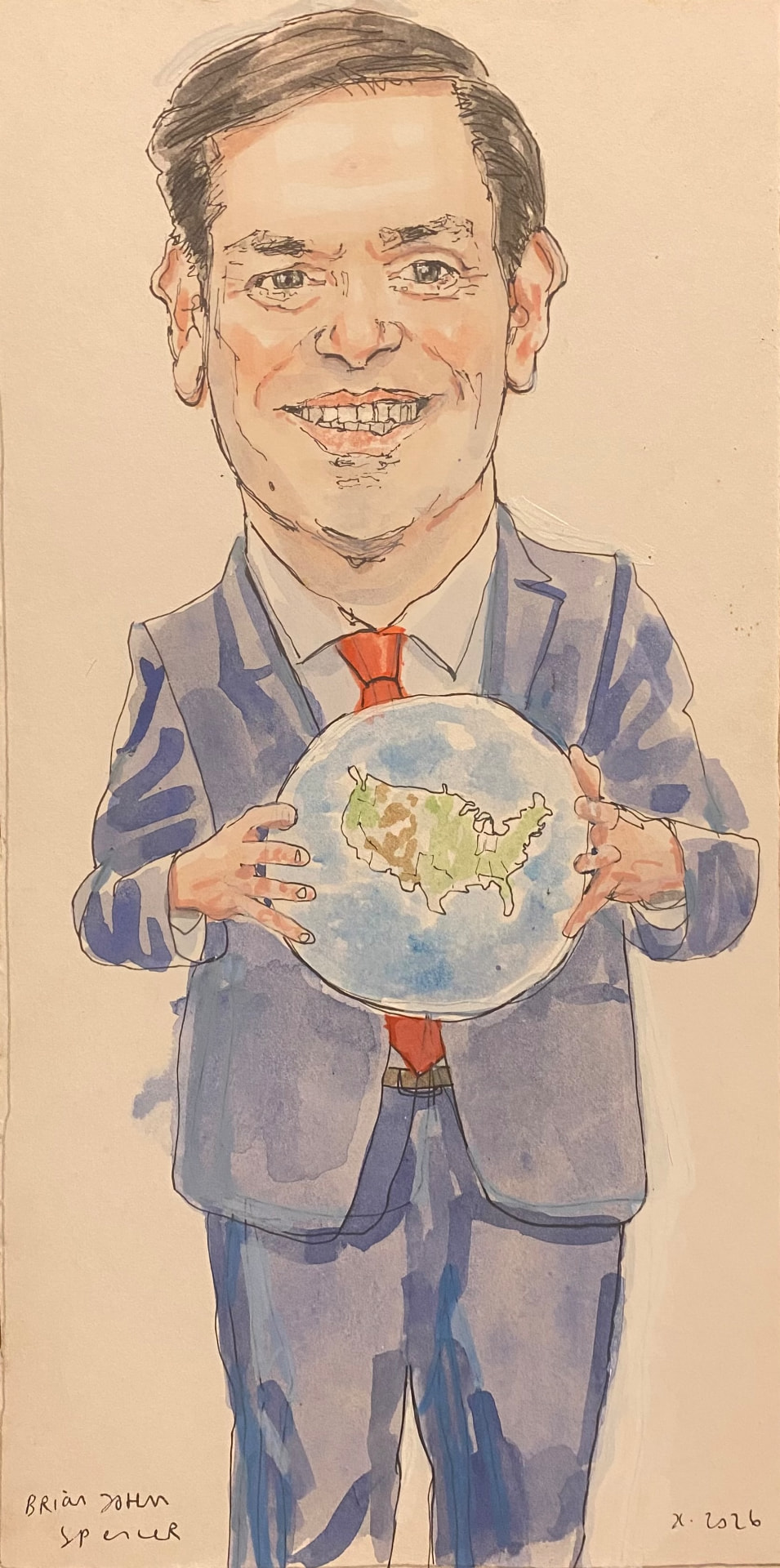
Marco Rubio, original watercolour caricature by Brian John Spencer
Marco Rubio. Brian John Spencer, 2026. Original watercolour. Courtesy of the artist.

Secretary of State Marco Rubio presents a different picture.

A former Speaker of the Florida House of Representatives and a three-term United States senator, Rubio has spent much of his political career at the intersection of domestic policy, national security and America's relationships with the wider world.

He has longstanding relationships on Capitol Hill and considerable familiarity with the legislative process.

His experience includes China, Latin America, Russia, NATO and the institutions through which the United States exercises influence abroad.

His appointment as Secretary of State placed him in a position that few contemporary American politicians can match.

But it is Rubio's recent public articulation of America's place in the world that has brought a new dimension to speculation about his political future.

On February 14, 2026, addressing the Munich Security Conference, Rubio delivered a substantial statement on the historic bonds between the United States and Europe, the shared inheritance of Western civilization, and the strategic challenges confronting the transatlantic alliance.

The address followed Vice President Vance's much-discussed intervention at the same conference a year earlier.

Where Vance had challenged European political leaders directly on matters of democracy, freedom of expression and political legitimacy, Rubio offered a broader historical argument about the foundations of the Western alliance and the responsibilities of its members.

The distinction was noteworthy.

Rubio did not suggest that Europe should abandon its national identities or that America should subordinate its interests to international institutions.

Rather, he argued that the alliance would be strengthened by renewed confidence in its shared cultural inheritance, national sovereignty and capacity to defend itself.

The speech demonstrated Rubio's ability to connect history, political philosophy and contemporary strategic concerns within a coherent public argument.

Then came Athens.

On October 7, standing at the ancient Pnyx, where Athenians once gathered to exercise their democracy, with the Acropolis and Parthenon rising behind him, Rubio delivered an address that attracted attention beyond the diplomatic community.

The setting was extraordinary.

Here, in the birthplace of Athenian democracy, the questions of political authority, justice and good government have occupied Western thought for more than two millennia.

It was in Athens, during the generations that followed the flowering of its democracy, that Plato wrote The Republic—one of the foundational Great Books of Western civilization.

Through the conversations of Socrates, Plato examined the meaning of justice, the ordering of society and, above all, the character and wisdom required of those entrusted with power.

His famous proposition that rulers should possess the wisdom of philosophers was not an endorsement of democracy as Athens practised it. Indeed, The Republic challenged many of its assumptions.

But Plato's questions have endured long after the institutions of ancient Athens disappeared.

What makes a society just? What qualifies a person to govern? And should political power be pursued for its own sake—or exercised in service of something greater?

Standing before the Acropolis, Rubio was speaking in a place where those questions were hardly new.

As evening descended over Athens, he reached back more than two millennia to examine the inheritance of ancient Greece, the development of Western civilization and the relationship between national ambition, sovereignty and political power.

He spoke of the Greeks' influence upon America's founding institutions, of Rome and European Christendom, and of the character and determination required to sustain a civilization.

He connected that historical account to the realities of contemporary international relations: the return of great-power competition, the demands of national security, the vulnerability of industrial and technological supply chains, and the need for Western nations to rediscover confidence in their own capacities.

It was a speech notable not simply for its subject, but for its construction and delivery.

Rubio demonstrated an evident command of his material, moving between classical history, political ideas and current strategic concerns without losing the thread of his argument.

Whether one accepts his interpretation of Western history or disputes elements of his political philosophy, the address deserves serious consideration.

It also demonstrated the rhetorical skills that would become consequential were Rubio eventually to seek the presidency.

Indeed, some commentators interpreted the Athens address as something approaching an unofficial declaration of presidential ambition.

On October 8, The American Spectator went so far as to describe it as the first speech of the 2028 presidential race.

Others saw in the address a carefully framed attempt to connect President Trump's America First programme to a wider philosophical account of Western identity and national purpose.

That interpretation has prompted debate.

Supporters regard Rubio's argument as a defence of Western civilization, sovereignty and the importance of national confidence. Critics question whether his emphasis on power, cultural inheritance and national identity gives sufficient weight to the traditions of individual liberty, universal rights and democratic self-correction that also emerged from the Western experience.

These are substantial questions, not merely differences of political presentation.

They concern the purposes for which national power is exercised, the responsibilities of alliances and the relationship between national interests and the international order.

In that sense, the questions raised by Plato in The Republic have lost none of their relevance.

For Rubio, they may also provide the foundation of a recognisable political identity beyond his service in the present administration.

Munich established the argument. Athens carried it onto a larger stage.

Neither speech constituted a declaration of candidacy.

But taken together, they offer a substantial public expression of the philosophy Rubio might bring to a future presidential campaign.

His oratory is plainly an asset. So, too, is his experience of international affairs and his willingness to engage with their historical and political complexities.

Whether these qualities would translate into support among Republican primary voters is another question.

Indeed, Rubio's position within the party has changed considerably since he first sought its presidential nomination in 2016.

The secretary now bears responsibility for advancing President Trump's foreign-policy priorities, some of which challenge longstanding Republican assumptions about alliances, trade and America's international obligations.

The distance between Rubio and the MAGA movement may therefore be considerably narrower than some observers imagine.

And there remains another possibility.

President Trump has spoken favourably of both Vance and Rubio, and speculation about a joint ticket persists.

For the moment, they need not be rivals.

But should both eventually seek the nomination, the contrast between their political experiences, international outlooks and approaches to public communication would be one of the more interesting dimensions of the contest.

Rubio's speeches at Munich and Athens suggest that, should he choose to enter the race, he would have no shortage of material with which to make his case.

The question is whether he intends to do so.

Donald Trump Jr. — The Family Standard

Donald Trump Jr. has never held elected office.

In ordinary circumstances, that might place him at a considerable disadvantage against a sitting vice president, a secretary of state and several experienced governors.

But these are not ordinary circumstances.

The Trump name is more than a family association. It has become a political identity, a fundraising force and, for millions of Americans, a symbol of opposition to the country's established political institutions.

Donald Trump Jr. has built substantial relationships within that movement.

Early polling has placed him among the better-known figures in the prospective Republican field, although behind Vance and Rubio.

The question is whether Republican voters would wish to perpetuate the Trump political dynasty—or prefer a successor capable of carrying its principles forward without the family name.

There is also a distinction between political influence and presidential ambition.

Donald Trump Jr. might prove consequential as a supporter, fundraiser and political organizer rather than as a candidate.

Until his intentions become clearer, his role in the succession conversation remains open.

Ron DeSantis — The Second Attempt
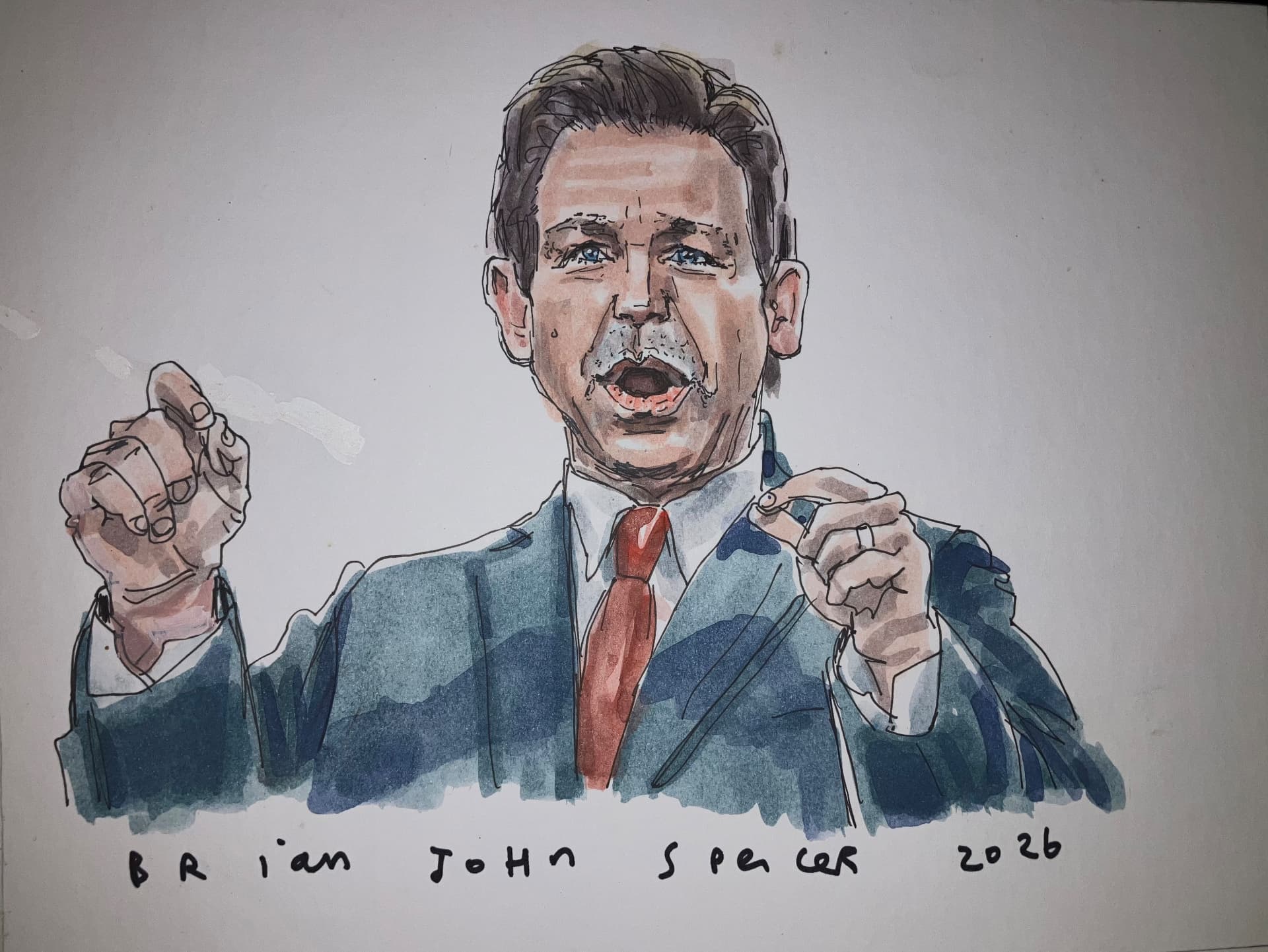
Ron DeSantis, original watercolour caricature by Brian John Spencer
Ron DeSantis. Brian John Spencer, 2026. Original watercolour. Courtesy of the artist.

Florida Governor Ron DeSantis has already discovered how unforgiving a Republican presidential primary can be.

His campaign for the 2024 nomination began with considerable expectations but failed to dislodge President Trump.

The experience exposed the difficulty of offering Republican voters a more disciplined version of the same political message while the movement's founder remained in the race.

By 2028, however, the circumstances will be different.

DeSantis will have completed his governorship, leaving him free to build a national political organization without the immediate demands of executive office.

His record in Florida provides substantial material for a campaign focused on conservative governance, taxation, education, regulation and the relationship between state and federal authority.

But he would confront two questions.

First, how would he distinguish his political programme from that of Vance and other figures identified with the current administration?

Second, could he demonstrate that his previous defeat was principally a consequence of the political circumstances of 2024 rather than a limitation in his national appeal?

There are second acts in American presidential politics.

They are simply harder to arrange than candidates sometimes imagine.

Glenn Youngkin — Head and Shoulders Above?
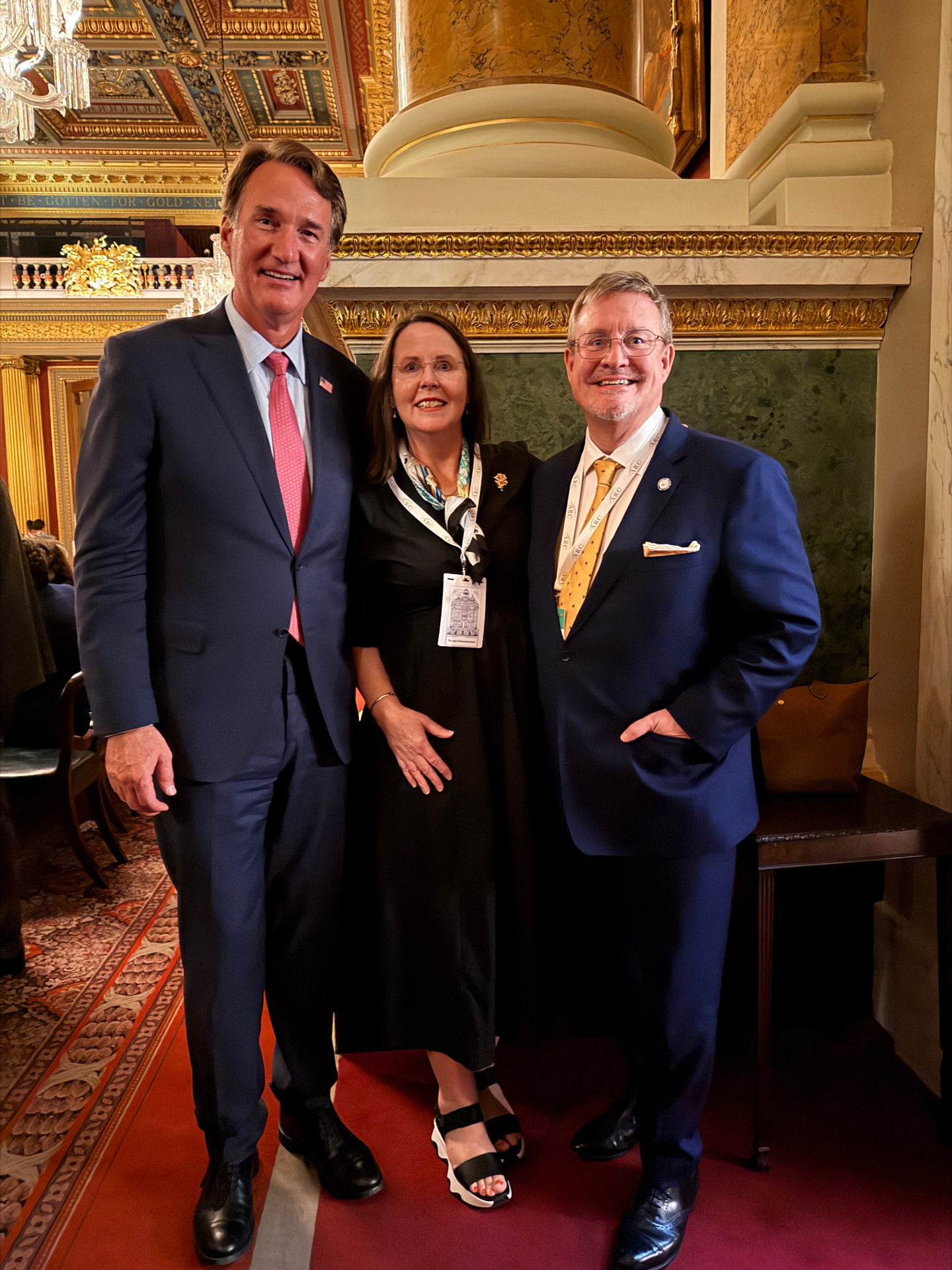
Former Virginia Governor Glenn Youngkin with Karen and Mark J. Finlay in London
Glenn Youngkin with Mark and Karen Finlay, London. Photograph from the Diplomatique™ archive.

Among the current and former governors who might enter the Republican presidential contest in 2028, Glenn Youngkin deserves particular attention.

There is something about Youngkin’s physical presence that photographs convey more readily than words. Tall, assured and comfortable in his own skin, he possesses the bearing that Americans have often associated with presidential leadership.

But stature is about rather more than height.

Youngkin came to politics from the world of business, having served as co-chief executive of the Carlyle Group, before winning the governorship of Virginia in 2021. His victory demonstrated an ability to reach voters beyond the Republican Party’s most committed supporters, while retaining much of the conservative coalition. Education, parental rights and the responsibilities of government to families were central to that campaign.

He governed Virginia from January 2022 until January 2026, pursuing tax reductions, economic investment, education reform and regulatory changes, while confronting a legislature in which Democrats exercised significant influence for much of his tenure. That combination of business experience, executive responsibility and electoral appeal makes him an intriguing prospect for 2028.

Youngkin has not declared a 2028 candidacy and has previously indicated that he does not plan to run. His continuing national activities should not be mistaken for a declaration.

In August 2026, he launched Empowering America's Parents, promoting education choice and a federal scholarship tax credit across multiple states. He has also campaigned for Republicans outside Virginia; September reporting disclosed a $100,000 contribution from his nonprofit organization to One Nation, a conservative group associated with Republican Senate electoral efforts. These are concrete activities, whatever conclusions observers may draw about their ultimate purpose.

His political identity remains rooted in business leadership and executive government at state level. He supported President Trump in 2024, but his career has not depended entirely upon membership of the MAGA movement. Could the next Republican nominee retain its supporters while assembling a broader electoral coalition? Virginia offers one example, not proof that the same approach would succeed in a presidential primary.

Yet appearances can deceive. When Samuel was sent to anoint Israel’s future king, he was reminded: “For the LORD sees not as man sees: man looks on the outward appearance, but the LORD looks on the heart.” — 1 Samuel 16:7 (ESV).

A useful caution for political observers, not least those tempted to confuse presidential bearing with presidential character.

Youngkin may stand head and shoulders above many of his prospective rivals. Whether he possesses the political judgement, conviction and appetite to lead them is a more important question.

Nikki Haley — A Changing South Carolina Calculation

Former South Carolina Governor Nikki Haley occupies a different position in the emerging Republican field.

She served as United States Ambassador to the United Nations during President Trump's first administration and subsequently challenged him for the Republican presidential nomination in 2024.

Her campaign attracted support among Republicans seeking an alternative to President Trump's leadership, particularly among traditional conservatives and voters dissatisfied with the party's direction.

But her challenge did not displace President Trump, and there is little public evidence of a substantial movement within MAGA seeking to establish Haley as his political successor.

There is another consideration that deserves attention.

Haley is not the only former South Carolina governor whose name belongs in a discussion of the political future.

David Beasley, who governed the state from 1995 to 1999, has begun an increasingly visible national effort to bring Americans together across their political, cultural and religious differences.

His Breaking Bread Together initiative encourages people who disagree to sit down, share a meal, listen to one another and rediscover common ground.

Beasley's national outreach raises an intriguing question about whether this reconciliation effort might also provide the foundations for a more explicitly political undertaking.

It has some of the characteristics observers examine when assessing early presidential ambitions: a national message, public appearances, the cultivation of relationships and an attempt to engage Americans beyond established party boundaries.

But civic outreach and presidential campaigning are not the same thing.

The relationship between these two former South Carolina governors also merits consideration.

Both have served as Republican governors. Both have international experience and relationships extending well beyond their home state. Both retain connections within South Carolina's political community.

Would Haley contemplate another presidential campaign if Beasley were to enter the field?

Might she instead choose to lend her influence to a former governor pursuing an appeal to the political centre?

Or would their distinct constituencies and ambitions lead them in separate directions?

There is no public evidence establishing how Haley would answer those questions, and her decisions should not be presumed.

We return to Beasley in our examination of The Unclaimed Centre, where his international experience, faith-based relationships and emerging national outreach deserve fuller consideration.

The Other Horses in the Paddock

The prospective field extends beyond those examined in detail.

Georgia Governor Brian Kemp has maintained considerable political influence despite periods of disagreement with President Trump.

Senator Ted Cruz retains a national conservative following and the experience of a previous presidential campaign.

Health and Human Services Secretary Robert F. Kennedy Jr. occupies a particularly unusual position. His political history crosses party boundaries, and his views on public health and government institutions have attracted both devoted supporters and substantial criticism.

And Vivek Ramaswamy, currently seeking the Ohio governorship, represents a younger generation of conservative leadership. His immediate electoral task may shape the direction of any subsequent national ambitions.

These individuals do not begin on equal terms.

Indeed, most may never declare.

But a political field that appears settled two years before an election has a remarkable capacity to rearrange itself.

What the Midterms Will Tell Us

The November elections will provide the first substantial evidence about the political conditions the eventual Republican nominee may inherit.

Will Republican voters turn out in sufficient numbers without President Trump's name on the ballot?

Will the party retain its foothold among working-class voters while recovering support in the suburbs?

Will economic concerns outweigh arguments about immigration, national security and cultural identity?

And what happens if Republicans lose control of the House—or the Senate?

The answers will matter to every prospective candidate.

For Vance, the result may strengthen or complicate the argument for continuity.

For Rubio, it may help determine how his international experience and emerging public philosophy fit the party's changing political priorities.

For Youngkin, the result may help illuminate the wider relevance of the suburban and family-centred approach associated with his Virginia victory.

For DeSantis, Haley and others, the result could shape discussions about whether the party should maintain its present direction or reconsider elements of its approach.

But one distinction should remain clear.

President Trump may be able to influence who wins the Republican nomination. The American electorate will decide whether that person becomes president.

Those are two very different contests.

And the distance between them may prove decisive.

II. The Democrats

A Crowded Field — And a Contest Over the Political Centre

If the Republicans are preparing for a succession, the Democrats face a rather different problem.

They must decide what sort of party they wish to become—and which political approach can restore their fortunes after the presidential defeat of 2024.

Some believe the answer lies in recovering the working-class voters who once formed the backbone of Democratic electoral success. Others argue that Democrats must mobilize younger voters and become more forceful in advancing progressive policies.

Still others believe the party's challenge is less ideological than practical: convincing Americans that Democrats can govern competently, make everyday life more affordable and restore confidence in public institutions.

All three arguments contain elements of truth.

For now, California Governor Gavin Newsom is among the most visible prospective contenders.

But the Democratic Party has another question to consider.

Could a candidate whose political experience has been forged in Republican-leaning territory offer a different approach to national leadership?

Kentucky Governor Andy Beshear and former North Carolina Governor Roy Cooper bring that possibility into focus.

Their experience is different from Newsom's. So, too, are the political constituencies they have learned to address.

And the November 3 midterms may provide important evidence about the arguments each represents.

The Donors Are Asking Questions Too

Behind the public manoeuvring, another conversation is taking place.

In discussions with significant Democratic Party donors, I have encountered a growing concern about the need for clarity—not simply over who might lead the party in 2028, but over the programme that leadership would represent.

Their immediate attention is understandably fixed upon the midterms.

They hope that November 3 will deliver a Democratic majority in the House of Representatives, giving the party an opportunity to move beyond opposition to President Trump and begin articulating a coherent alternative programme for the country.

But winning control of the House would be only the beginning.

A Democratic majority would have to demonstrate that it could develop an agenda, establish priorities and communicate them in terms that resonate beyond the party's established constituencies.

And it would have to do so while confronting an administration with no apparent intention of surrendering the political initiative.

A wounded administration under President Trump would not necessarily retreat. It might instead accelerate.

Should Democrats capture the House, President Trump would retain the presidency, control of the executive branch and the considerable powers of his office for another two years.

Deprived of a cooperative House, the White House could respond with an intensified barrage of executive orders, presidential memoranda, administrative directives and regulatory action—using every available instrument of executive authority to advance its programme.

The existing stream of presidential directives could become a torrent.

And the greater the obstacles encountered on Capitol Hill, the stronger the temptation to pursue policy through executive action rather than congressional legislation.

At the opposite end of Pennsylvania Avenue, a Democratic House would have its own weapons: committee investigations, subpoenas, appropriations negotiations, legislative initiatives and the power to summon administration officials to account for their decisions.

The confrontation could be relentless.

But the battle would not be confined to Pennsylvania Avenue.

It would spill into the federal courts, where arguments over executive authority, statutory interpretation, administrative procedure and constitutional limits would become another theatre of the struggle between the branches of government.

District courts would confront challenges to presidential and administrative action. Courts of appeals would review disputed rulings. And questions of sufficient legal or constitutional significance could ultimately reach the Supreme Court of the United States.

SCOTUS could once again find itself at the centre of arguments about the separation of powers and the boundaries of presidential authority.

The courts, of course, are not another political opposition party. Their responsibility is to adjudicate disputes according to law. Nor can executive orders override statutes or the Constitution.

But that will hardly prevent political actors on both sides from treating consequential judicial rulings as victories or defeats in the broader national contest.

The legislature would legislate, investigate and obstruct where its lawful powers permit. The executive would direct, regulate and defend. The litigants would sue. And the courts would be asked to determine where authority begins and ends.

Meanwhile, along K Street, Washington's lawyers, lobbyists, consultants and government-relations specialists would find no shortage of clients seeking advice, influence, protection or advantage.

For businesses, investors, state governments, universities, charities and international partners, the consequences could be substantial.

An executive order issued on Monday might prompt a legal challenge on Tuesday, a congressional hearing the following week and months of uncertainty about whether the policy would survive.

The regulatory environment could become increasingly difficult to navigate. Businesses would have to assess not merely what the rules say, but whether those rules might be challenged, suspended, rewritten or overturned.

And the airwaves?

They would be alight.

Every presidential directive, congressional investigation, judicial injunction and Supreme Court ruling would be subjected to competing interpretations across television, radio, podcasts and social media.

The political confrontation would become a daily spectacle, with the opening stages of the 2028 presidential contest unfolding against its backdrop.

Even if Republicans retain control of Congress, the administration will still face the pressures of a presidency approaching its final two years, an increasingly active succession debate and continuing legal and political challenges.

Either way, the coming period promises little respite for Washington.

For the lawyers and lobbyists of K Street, it could prove exceptionally lucrative. For Americans seeking stable and predictable government, the consequences may be less welcome.

And that brings us back to the Democratic donors.

The concerns expressed to me extend to the presidential field.

There is little appetite among these donors for a prolonged period of confusion in which competing personalities, factions and ambitions obscure the larger question of what Democrats intend to offer the American people.

They are looking for coherence: a credible programme, a recognisable national message and a prospective presidential candidate capable of giving both direction.

This is not to suggest that the party's donors speak with one voice, nor that presidential nominees should be selected in private conversations among those who finance campaigns.

Ultimately, Democratic primary voters will make that decision.

But those who have invested substantially in the party's electoral efforts are already considering the relationship between the next Congress and the presidential contest that follows.

Can a newly elected Democratic House, should voters give the party control, help establish a governing agenda around which the eventual presidential nominee can build a national campaign?

And can the party develop that agenda without allowing the contest between its moderate and progressive wings to overwhelm the message?

These questions help explain why the emerging presidential field deserves examination before the midterms.

They also provide a useful framework through which to consider Gavin Newsom, Andy Beshear, Roy Cooper and the other prospective contenders.

For the Democrats, the challenge is not simply to identify a candidate.

It is to decide what that candidate is being asked to lead.

Gavin Newsom — The California Proposition

Governor Gavin Newsom has spent much of 2026 increasing his national visibility, supporting Democratic candidates and positioning himself in opposition to President Trump's administration.

His California governorship gives him an extensive record in economic development, public policy and executive leadership.

His state is home to some of the world's largest technology companies, major ports, universities and international investment networks.

It is also associated with formidable challenges involving housing affordability, homelessness, taxation and public spending.

A presidential campaign would bring both sides of that record under scrutiny.

Newsom's communication style is confrontational, his fundraising relationships are substantial, and his willingness to engage Republicans directly has attracted national attention.

Yet a Democratic presidential nominee must do more than command attention among voters already opposed to President Trump.

The candidate must develop a programme capable of addressing Americans whose economic and political circumstances bear little resemblance to those of California.

That brings two governors from the Southeast into the conversation.

Andy Beshear — Faith, Family and the Rural Heartland

Kentucky Governor Andy Beshear offers a different account of Democratic political leadership.

He has twice been elected governor in a state whose voters have repeatedly supported Republican presidential candidates.

His approach combines practical government, economic development, healthcare and a willingness to speak openly about Christian faith and family life.

In communities where national Democratic messages have often struggled to find an audience, Beshear has developed relationships that cross party boundaries.

His role as chair of the Democratic Governors Association has also brought him into campaigns beyond Kentucky, including states where Democrats face difficult electoral conditions.

This experience raises a question for 2028.

Could the party develop a national programme capable of engaging the rural communities and smaller industrial towns where it has lost ground?

Beshear's record is relevant to that debate.

But another figure introduces a complication to the political arithmetic.

Former South Carolina Governor David Beasley, whose national Breaking Bread Together initiative is seeking common ground across political and cultural divides, addresses some of the same communities and values that feature in Beshear's political approach.

Both men speak openly about faith. Both have experience in states where Republican presidential candidates enjoy substantial support. Both place personal relationships and engagement across disagreement near the centre of their public message.

They are not pursuing identical political programmes, and Beasley has not declared a presidential candidacy.

Nevertheless, if Beasley's initiative were to develop into an independent presidential effort, how much overlap might exist between the constituencies he attracts and those a national Beshear campaign would seek to engage?

That question cannot presently be answered with polling.

But it illustrates why an independent candidacy appealing to faith communities, rural voters and political moderates could complicate the calculations of either major party.

We return to Beasley in The Unclaimed Centre.

Roy Cooper — The North Carolina Test

Former North Carolina Governor Roy Cooper faces a rather different examination.

He is not campaigning for president.

He is campaigning for the United States Senate against Republican Michael Whatley.

But the outcome of that contest may influence the national Democratic conversation.

North Carolina has repeatedly supported President Trump in presidential elections while also electing Cooper to two terms as governor.

His political experience therefore provides a case study in Democratic electoral success in a state where national Republican candidates have remained competitive.

Cooper's Senate campaign has concentrated on affordability, healthcare and practical government.

His record of negotiating Medicaid expansion with a Republican-controlled legislature gives him a concrete example of governing across party boundaries.

And North Carolina's changing political character makes the contest particularly instructive.

The state contains growing metropolitan and suburban communities, substantial university and technology centres, established military interests, agricultural regions and smaller towns where economic and cultural concerns differ considerably.

It is increasingly competitive in statewide elections, although presidential voting has remained Republican.

Polling during October has shown Cooper leading Whatley, but the strength of that lead varies with the poll and aggregation method.

North Carolina Senate polling — RealClearPolling

If Cooper wins on November 3, what will the result tell us about the political coalition he has assembled?

His margin of victory, geographic distribution of support and performance among unaffiliated voters will all merit close examination.

A victory would not constitute a declaration of presidential ambition.

Indeed, Cooper would enter the Senate in January 2027 with a six-year mandate from North Carolina's voters.

Whether he would wish to pursue another office so quickly is uncertain.

But his performance could become an important point of reference for Democrats debating how to appeal beyond their established constituencies.

And if the result is significantly closer than present polling suggests, that too would require explanation.

For Cooper, the immediate race is for the Senate.

For the Democratic Party, the implications could extend considerably further.

Kamala Harris — The Unfinished Campaign

Former Vice President Kamala Harris retains national recognition, substantial political relationships and considerable influence within the Democratic Party.

She also carries the experience of defeat in the 2024 presidential election.

That creates a difficult calculation.

Her supporters can point to the extraordinary circumstances of her previous campaign, including the limited time available following President Biden's withdrawal.

Others within the party question whether a second Harris candidacy would help Democrats establish a new political direction.

Recent reporting has indicated that some former aides and supporters doubt she will ultimately pursue another nomination.

But Harris herself has not closed the door.

Her continued involvement in the 2026 midterm campaigns could be consistent with preparing for another presidential effort, maintaining political influence or both.

There is also the question of what role leading Democrats might encourage her to play after November.

Some may favour another candidacy. Others may seek her support in developing a new generation of Democratic leadership.

For now, it would be premature to treat either outcome as settled.

Her eventual decision could substantially change the composition of the Democratic field.

Alexandria Ocasio-Cortez — The Progressive Standard

Representative Alexandria Ocasio-Cortez represents a different political tradition within the Democratic Party.

She has become one of its most recognisable progressive voices, particularly among younger voters and those seeking substantial changes in economic and social policy.

Her national profile, media presence and political relationships give her influence extending well beyond her New York congressional district.

Should she seek the presidential nomination, she would bring an identifiable progressive programme into the contest.

But the November midterms offer an earlier opportunity to examine the political movement with which she is associated.

How will candidates backed by progressive organizations perform in competitive districts and statewide races?

Will they increase turnout among younger voters?

Will their economic arguments resonate in communities concerned about wages, housing, healthcare and the cost of living?

And can progressive candidates establish support beyond districts already inclined to elect Democrats?

The evidence may be mixed.

Some Democratic candidates in competitive constituencies have been reluctant to associate their campaigns publicly with Ocasio-Cortez, reflecting disagreements within the party about the electoral implications of her political positions.

Yet progressive candidates and organizations are continuing to pursue opportunities in the midterms.

The results will provide evidence not simply about Ocasio-Cortez personally, but about the direction and reach of the wider progressive movement.

Whether that movement ultimately coalesces around her, another prospective candidate or several competing figures remains open.

The important question is how its ideas and electoral organization develop between November 2026 and the presidential primaries.

Josh Shapiro — The Pennsylvania Proposition

Pennsylvania Governor Josh Shapiro represents another approach to Democratic political leadership.

Pennsylvania occupies a central position in the arithmetic of presidential elections.

Shapiro has demonstrated an ability to win statewide support in a competitive political environment, combining executive experience with an accessible public manner.

His supporters argue that his record offers a model for Democratic candidates seeking to appeal across traditional political boundaries.

There are complications.

Shapiro's strong support for Israel and his positions on contentious domestic issues have attracted criticism from parts of the Democratic left.

A presidential primary could expose those disagreements.

But Pennsylvania will remain central to the national political conversation, and Shapiro's record will inevitably attract attention.

Gretchen Whitmer — The Industrial Midwest

Michigan Governor Gretchen Whitmer understands the political importance of manufacturing, organized labour and communities whose economic fortunes have been transformed by globalization.

Michigan is one of the great battlegrounds of American politics.

Whitmer's experience governing the state gives her a record around jobs, infrastructure, industrial policy and the economic concerns of working families.

Her political approach raises questions about how Democrats might engage voters attracted by President Trump's promises to rebuild American manufacturing.

Yet a successful record in state office does not automatically translate into a national campaign.

Whether Whitmer wishes to undertake that campaign remains open.

JB Pritzker — Money, Machinery and Political Resolve

Illinois Governor JB Pritzker possesses political resources that relatively few prospective candidates can match.

His personal wealth provides considerable freedom from the early fundraising constraints faced by other candidates.

But his political significance should not be reduced to his financial position.

Pritzker has developed a forceful national profile, confronting the administration while seeking to expand Democratic organization beyond the party's strongest urban constituencies.

His challenge would include demonstrating how his governing experience and economic programme address the concerns of voters outside Illinois.

Money can finance an extensive campaign.

It cannot answer every question about the direction a candidate wishes to take the country.

Pete Buttigieg — The Articulate Campaigner

Former Transportation Secretary Pete Buttigieg remains one of the Democratic Party's most recognisable communicators.

His unsuccessful campaign for the 2020 nomination introduced him to a national audience and demonstrated his ability to compete against politicians possessing greater experience in national office.

His service in the Biden administration, military background and experience as mayor of South Bend give him a varied public biography.

Supporters point to his ability to explain complex policies and engage audiences that Democrats have sometimes struggled to reach.

Critics question whether his executive and administrative experience provides sufficient preparation for the presidency.

There is also a generational argument.

Buttigieg would offer a contrast with the older political figures who have dominated recent presidential elections.

Whether he seeks to develop that argument into another candidacy remains to be seen.

Wes Moore — A Different Generation of Leadership

Maryland Governor Wes Moore has attracted attention as a possible future national leader.

A military veteran, author and former charitable-sector executive, Moore brings an experience of public service that differs from the conventional political career.

His personal story allows him to address questions of opportunity, responsibility and national purpose.

But experience also matters.

Moore has served as governor only since January 2023. His national ambitions, if they develop, will be assessed against a relatively short record in elected office.

For now, his significance lies partly in what he may represent to the Democratic Party's next generation.

Rahm Emanuel — The Renewal Argument

Few prospective contenders bring a more varied institutional record. Rahm Emanuel served three terms as a Democratic congressman from Illinois, stood at President Obama's side as White House chief of staff, governed America's third-largest city as mayor of Chicago for two terms, and most recently represented the United States as ambassador to Japan.

He is publicly considering a campaign for the 2028 Democratic presidential nomination. He has not declared one. CBS Chicago reported on 8 October 2026 that he will make his decision after the midterm elections.

The groundwork, however, is visible. The Associated Press documented his 'Spin-Free' cycling tour through New Hampshire in June 2026, with visits and policy themes that tested the waters of the first primary state. WBUR reported his own comments on considering a bid in May.

His argument is distinctive. Axios reported in January 2026 his case for a 'renewal wing' of the Democratic Party: pragmatic, centrist and focused on education, economic security and the competence of government itself.

Whether that argument can carry a man who has held so many different kinds of power remains an open question. Consideration is not declaration, and the midterms will shape his calculation as they will shape every other calculation in this field.

The Senators Who May Matter

Several senators remain relevant to the broader presidential conversation.

Arizona's Mark Kelly offers a background in military aviation, space exploration and national security.

His fellow Arizona senator Ruben Gallego brings military experience and an electoral record in a competitive state.

New Jersey's Cory Booker remains a nationally recognised figure with a long record in public service and an ability to discuss faith, reconciliation and civic responsibility.

Georgia Senator Jon Ossoff is also frequently mentioned in discussions about the Democratic Party's future, although he has publicly rejected speculation about seeking the presidency in 2028.

He is concentrating on defending his Senate seat.

Not every politician with an attractive national profile is necessarily preparing a presidential campaign.

Some may exert more influence by concentrating on the offices they already hold.

What the Democrats Must Decide

The field is sizeable. The ideological differences are real.

But the midterms may help answer three questions.

First, can Democrats recover enough support among working-class and rural voters to compete outside their traditional strongholds?

Second, does the party's future lie principally with progressive candidates capable of increasing turnout, or with governors and senators who can appeal to voters across party boundaries?

Third, can Democrats advance a credible economic programme for an age increasingly shaped by artificial intelligence, industrial change and the pressures facing middle-income families?

These questions are connected.

The coming technological transformation may prove particularly consequential.

Both parties speak about American leadership in artificial intelligence. But political candidates will also have to address what happens to employment, education, wages and regional economies when technology begins to change the nature of work.

For Democrats, this represents both an opportunity and a difficulty.

They may be able to make a persuasive case for protecting workers and communities through periods of rapid change.

But they will have to do so without appearing hostile to the innovation, capital investment and enterprise on which much of America's economic strength depends.

The eventual Democratic nominee must persuade voters that the party has more to offer than opposition to President Trump.

The party needs a candidate capable of explaining not only what Democrats are against, but what they intend to build.

And that brings us to the political ground between the two parties.

III. The Unclaimed Centre

David Beasley — The Man Between the Parties

Electoral scenarios in this chapter are hypothetical, not evidence of a planned candidacy.

He began his political career as a Democrat. He governed South Carolina as a Republican. Now David Beasley says he is simply an American.

Between the prospective Republican and Democratic presidential contenders lies a political territory that neither party can afford to ignore.

It is inhabited by Americans who may be conservative in their personal convictions but dissatisfied with the conduct of political debate.

Others are more liberal in their outlook but concerned about the direction of the Democratic Party.

Many are less interested in ideological labels than in competent government, economic security, public trust and the prospect of a country less consumed by internal conflict.

This middle ground is neither politically uniform nor necessarily committed to finding a third-party candidate.

But it exists.

And one figure whose experience merits consideration in this context is former South Carolina Governor David Beasley.

Beasley is an unusual American public servant.

He began his political career as a Democrat, later became a Republican and served as Governor of South Carolina from 1995 to 1999.

After more than three decades as a Republican, he announced in October 2026 that he was leaving the party—without claiming another.

He subsequently developed an international career that few former American governors could have anticipated.

From 2017 until 2023, Beasley served as Executive Director of the United Nations World Food Programme.

During those years, the organization confronted some of the world's most demanding humanitarian emergencies, responding to conflict, displacement, famine and the consequences of political collapse.

In 2020, the World Food Programme received the Nobel Peace Prize.

Beasley accepted the award on behalf of an organization whose work reaches people irrespective of their nationality, religion or political allegiance.

He subsequently led efforts that helped the programme reach more than 160 million people during 2022.

That is a record of international humanitarian leadership on a substantial scale.

But it is Beasley's relationships, rather than his résumé alone, that distinguish him.

He has engaged with heads of state, senior ministers, international institutions, humanitarian organizations and faith leaders across much of the world.

He knows people in countries that rarely feature prominently in American political conversation until a crisis erupts.

He has negotiated humanitarian access in circumstances where conventional diplomatic engagement can be exceptionally difficult.

And he has done so while maintaining a distinctly personal approach to leadership.

Personal disclosure: I have known David Beasley for years and have travelled with him. I regard him as a friend. Those experiences have given me an opportunity to observe qualities that do not always emerge through formal biographies or political reporting. They also impose a particular responsibility to distinguish my personal regard for him from an assessment of his electoral prospects.

Breaking Bread Together — A Search for Common Ground

In August 2026, Beasley launched Breaking Bread Together, a national initiative encouraging Americans of differing political, cultural and religious convictions to sit down together, share meals, listen and search for common ground.

The proposition is simple.

People who disagree need not cease talking to one another.

Nor must friendship depend upon agreement.

Beasley's approach reflects a conviction that personal relationships can create opportunities for cooperation where institutional or political dialogue has broken down.

This is not merely a statement about the tone of political debate.

It is an attempt to organize real conversations in a country where differences of opinion increasingly separate neighbours, families and communities.

Read about Breaking Bread Together — Charleston City Paper

The political implications are intriguing.

A national initiative built around reconciliation can generate visibility, relationships, organizational capacity and a recognisable public message.

These are also attributes associated with the exploratory stages of presidential politics.

But a reconciliation initiative is not necessarily a presidential campaign.

Beasley has not formally declared a presidential candidacy, and his public activity should not be presented as a formal exploratory committee without evidence. No further announcement about his political future is expected imminently.

Nevertheless, the initiative belongs in any serious examination of political leadership beyond the traditional party divisions.

'An American' — Leaving the Republican Party

In October 2026, Beasley announced publicly that he was walking away from the Republican Party after more than three decades within it.

Speaking with Amna Nawaz on PBS NewsHour on 21 October, he attributed his departure to the rhetoric of the party's standard-bearer, which he described as demeaning, and lamented a rise in toxic vitriol in American political debate.

Asked about his political identity, Beasley did not claim another party. He described himself instead as an American.

The declaration is significant precisely because of the ground it leaves unclaimed. A man who began as a Democrat, governed as a Republican and now declines both labels embodies the territory this section considers.

Beasley is not expected to make any further announcement about his political future for some time. His departure from the Republican Party is a statement about political identity and the conduct of public debate—not the opening of a campaign.

Watch the PBS NewsHour interview — 21 October 2026

From South Carolina to the National Stage

In April 2026, I travelled from Charleston to Columbia with several men from our Come Further Up, Come Further In! fellowship to hear David Beasley deliver the keynote address at the 64th South Carolina Prayer Breakfast.

The reception was warm, reflecting the affection and respect Beasley continues to command in his home state.

Here was a former governor whose subsequent international responsibilities had brought him into contact with kings, presidents, prime ministers, humanitarian agencies and communities devastated by war and hunger.

But the faith community gathered in Columbia was not simply familiar territory to which Beasley had returned after years on the international stage.

It was his natural habitat.

His Christian faith, the relationships formed through prayer and fellowship, and his conviction that people can find common ground even across profound differences have long shaped his approach to public life.

David would describe himself as a follower of Jesus. That is an important distinction in understanding how he approaches relationships.

His faith is not simply a private conviction or a label attached to his public life. It informs the way he approaches people, builds friendships and seeks common ground, even where profound differences exist.

Indeed, it was from that foundation, and with the confidence and moral authority it provided, that Beasley went on to engage, befriend and encourage kings, presidents, prime ministers and other leaders across the world—often across political, religious and cultural divides that others might regard as insurmountable.

These relationships have included engagement with His Highness Sheikh Mohamed bin Zayed Al Nahyan, President of the United Arab Emirates; Mohammed bin Salman, Crown Prince and Prime Minister of Saudi Arabia; and King Abdullah II of Jordan.

These are leaders of Muslim-majority nations, within whose Islamic tradition Jesus is honoured as a prophet, although not understood in the same way as in Christianity.

Such theological differences need not prevent friendship, mutual respect or cooperation in the service of people facing hunger, displacement and conflict.

Beasley's approach illustrates a distinction too often lost in contemporary political and religious debate: the ability to hold firmly to one's convictions while extending friendship to those who do not share them.

His international experience did not displace those foundations. It gave them a much wider field in which to operate.

His subsequent launch of Breaking Bread Together can be understood in that same context.

But there is an important distinction between being warmly received by people who already know one's story and establishing recognition across the American electorate.

Can the personal regard Beasley commands in South Carolina, and the international stature he earned at the World Food Programme, translate into recognition among voters from California to New York, across the heartland and throughout the industrial states that proved so consequential to President Trump's victories?

His humanitarian achievements are substantial. But they are not necessarily familiar to the ordinary American voter.

His national reconciliation initiative provides an opportunity to introduce himself and his ideas to new audiences. It does not, by itself, establish a presidential campaign.

Whether Beasley ultimately chooses to seek elected office or continue building bridges outside party politics, the question of how far his message can travel is worth watching.
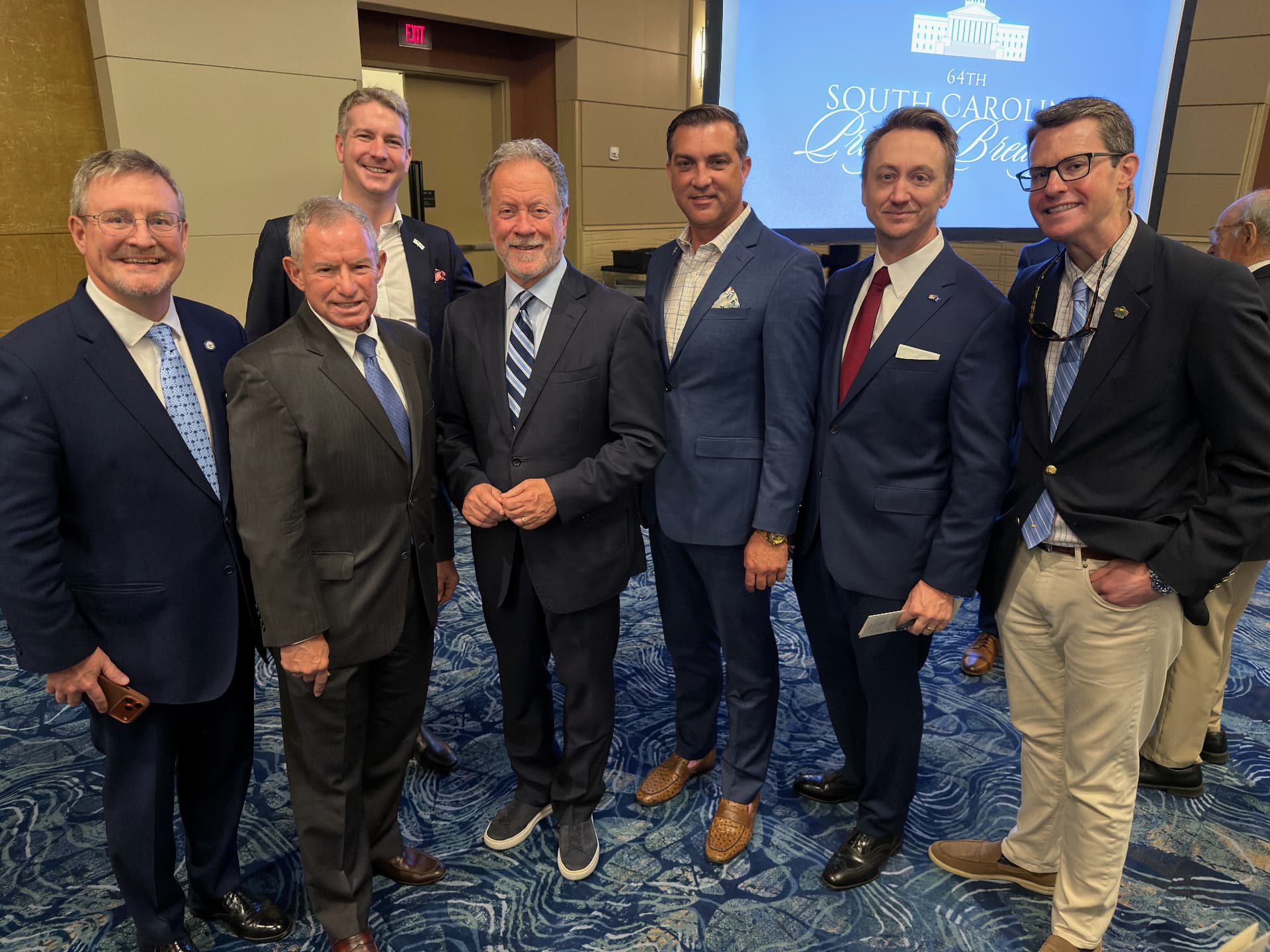
Mark J. Finlay with members of the Come Further Up, Come Further In! fellowship and Governor David Beasley (centre) at the 64th South Carolina Prayer Breakfast, Columbia
Mark J. Finlay with fellow members of the Charleston-based Come Further Up, Come Further In! fellowship and former South Carolina Governor David Beasley at the 64th South Carolina Prayer Breakfast, Columbia, April 2026. Courtesy of Mark J. Finlay.
A Presidential Path?

Nothing in Beasley's public statements suggests an imminent candidacy, and this examination does not assume one. But the structural questions any unconventional candidacy would face are worth setting out.

Personal regard and political arithmetic are different things.

I struggle to identify a convincing route by which David Beasley could become President of the United States in 2028.

That is not a judgment on his character or capacity for public service.

It is an assessment of the structural difficulties an unconventional candidacy would encounter.

If he sought the Republican nomination, he would confront a party whose primary electorate is heavily influenced by President Trump's political movement.

There is little public evidence of a national Beasley presidential campaign organization, fundraising structure or established Republican primary constituency comparable to those associated with more frequently discussed figures.

An independent candidacy would present a different and demanding set of challenges.

The United States has an electoral system that strongly favours its two principal parties. Ballot access varies from state to state. Presidential campaigns require extensive organization, substantial resources and a capacity to compete across a very large country.

And under the Electoral College, a candidate who attracts a respectable national percentage of the vote may still fail to win a single state.

But I can almost hear David Beasley challenging my political arithmetic.

He would remind me of the words of Jesus in Matthew 19:26 (NIV): “With man this is impossible, but with God all things are possible.”

And knowing David, he might go further, recalling Paul's counsel in 2 Corinthians 4:18 (NIV) that we should fix our eyes not on what is seen, but on what is unseen.

It would be entirely characteristic of a man whose life has been shaped by faith to caution against allowing present circumstances to define the limits of what might become possible.

I take that challenge seriously.

But neither faith nor friendship relieves us of the responsibility to examine political realities as they stand.

There is a distinction between believing that God can open doors which appear firmly closed and claiming to know which doors He intends to open.

Beasley's experience at the World Food Programme, and his relationships with leaders across the world, testify to a public career that has already travelled far beyond what might once have seemed a conventional political path.

Perhaps there are further chapters still to be written.

For now, the political route remains difficult to discern. But I would be the last to suggest that what we can presently see is all there is to the story.

And there is another consideration.

David Beasley would not necessarily have to win the presidency to change the outcome of the presidential election.

The Political Arithmetic of the Middle

Imagine a presidential election in which the two major parties are separated by only a few thousand votes across several battleground states.

An independent candidate appealing to moderate Republicans, conservative Democrats, faith communities and politically disengaged Americans could alter the result without coming remotely close to winning the presidency.

Indeed, the distribution of those votes might matter more than their national total.

It would be a mistake to assume that Beasley's supporters would come principally from one party.

His Republican political history might appeal to conservative voters dissatisfied with the eventual Republican nominee.

His humanitarian achievements and approach to international engagement might attract Democrats and independents.

His Christian faith and relationships across religious communities might also appeal to people whose political identities are more complicated than party labels suggest.

Some who supported him might otherwise have stayed at home.

Others might vote for one of the major parties in his absence.

That makes the electoral mathematics difficult to predict.

Consider, too, Andy Beshear.

Beshear's appeal in Republican-leaning Kentucky, his public expression of Christian faith and his emphasis upon family and practical government overlap in some respects with constituencies Beasley might seek to engage nationally.

Such overlap does not establish that the same individuals would support both men.

But if Beasley moved from civic outreach into an independent presidential campaign while Beshear sought the Democratic nomination, questions about their respective constituencies would become part of the electoral calculation.

The effect could extend to Republican candidates as well.

A candidate does not need to win an election to affect its result.

And this raises an important strategic question.

Would an independent Beasley candidacy help advance the principles he has spent much of his public life defending—or might it inadvertently make their advancement more difficult by changing the balance between the two principal contenders?

There is no simple answer.

But the question deserves consideration before anyone treats a third presidential candidacy as an uncomplicated expression of political dissatisfaction.

A Larger Contribution Than a Campaign?

There is another possibility.

The next president, irrespective of party, will inherit a nation suffering from deep political division and a world confronting serious humanitarian, diplomatic and security challenges.

The next administration will need people who understand not only the exercise of American power but also the cultivation of confidence, cooperation and practical relationships.

David Beasley has spent years working in precisely those circumstances.

He knows the humanitarian consequences of conflict.

He understands the complicated relationship between food security, migration, economic instability and political unrest.

And he has developed personal relationships with leaders across the international system.

Such experience would be relevant to several areas of government.

A future president from either party could consider drawing upon Beasley's experience in a senior advisory, diplomatic or appropriately constituted Cabinet-level role.

His contribution need not be limited to international affairs.

He possesses qualities that could be relevant within the United States itself, particularly in efforts to rebuild relationships across political and social divisions.

That is not to say that reconciliation requires Americans to abandon their convictions or disguise serious disagreements.

It requires something more demanding: the willingness to recognize the humanity of those with whom we disagree, to engage them seriously and to seek common ground where it genuinely exists.

Beasley has demonstrated a capacity for that form of engagement.

And while such relationships do not provide an obvious route through a presidential primary, they remain relevant to the work of government.

The Value of Those Who Do Not Win

American political commentary is understandably preoccupied with winners.

Who leads the polls? Who raises the most money? Who secures the endorsement? Who wins the nomination?

But political leadership cannot be measured only through electoral success.

Some of the most consequential people in government have never won an election.

Others have made their greatest contribution after their own electoral ambitions came to an end.

There are offices to be filled, institutions to be strengthened, relationships to be repaired and difficult decisions to be made.

These require people of ability, experience, integrity and good judgment.

David Beasley's public career offers substantial evidence of experience in several of these fields.

Whether he ever seeks the presidency is his decision.

Whether he could win it is another question entirely.

But a difficult electoral path should not be confused with an absence of public value.

The contribution David Beasley could make within a future administration deserves consideration quite apart from whether he ever seeks the presidency himself.

IV. The Final Stretch

What We Will Be Watching After November 3

The starting gates for the 2028 presidential contest remain open.

They will remain open for some considerable time.

Some of the names already being discussed will eventually declare their candidacies. Others will decide that the political conditions are unfavourable, their ambitions better pursued elsewhere, or that the cost of a presidential campaign is simply too high.

And there will almost certainly be surprises.

Candidates presently dismissed as outsiders may emerge with unexpected strength. Early favourites may stumble. Political alliances that appear secure today may prove remarkably temporary.

The November 3 midterms will provide the first substantial opportunity to reassess the field.

The Republican Question

The immediate test for Republicans is whether the political coalition assembled by President Trump can deliver electoral success when he is not himself on the ballot.

A strong Republican result would provide evidence for those arguing that the administration's political programme continues to command substantial support.

Substantial losses would raise questions about policy, political communication, candidate selection and the wider public's judgment of the administration.

Either outcome would influence the succession debate.

For JD Vance, the result may strengthen or complicate the argument for continuity.

For Marco Rubio, it may help determine how his international experience and emerging public philosophy fit the party's changing political priorities.

For Glenn Youngkin, the results in suburbs and competitive districts may offer evidence about the relevance of the political approach that brought him to the Virginia governorship.

For Ron DeSantis and others, the midterms could shape the debate about whether the party should maintain its present course or reconsider elements of its direction.

The Democratic Question

For Democrats, the midterms will be interpreted through several competing political arguments.

Progressives will examine turnout and enthusiasm among younger voters and the party's traditional constituencies.

Moderates will scrutinize results in suburban communities, competitive congressional districts and states where Democratic candidates have demonstrated an ability to attract independent voters.

The party's governors will seek evidence that their records in office offer a credible foundation for national leadership.

Particular attention should be paid to North Carolina.

If Roy Cooper wins his Senate contest, his performance will provide further evidence about Democratic electoral success beyond the party's established base.

His personal ambitions may remain modest.

The significance of his electoral example could nevertheless be substantial.

Kentucky and other Republican-leaning states will also provide information relevant to Andy Beshear's political approach.

And the results in races featuring progressive-backed candidates will offer evidence about the movement associated with Alexandria Ocasio-Cortez.

Behind all of this lies the argument increasingly evident in conversations with Democratic donors: the party needs more than a collection of personalities.

It needs a coherent message.

Should Democrats gain control of the House, they will have the opportunity to develop an agenda in Congress while confronting a president determined to use the powers of his office.

That confrontation could dominate the next two years.

The existing stream of presidential directives could become a torrent.

And if it does, the emerging presidential contenders will have to decide how they address the confrontation—not merely how loudly they oppose it.

The Question Beyond Both Parties

And what of the millions of Americans who are less concerned with which political faction wins an argument than with whether the country can be governed effectively?

They will be watching the same election through a different lens.

Can Washington work?

Can government provide a stable environment for investment, enterprise and employment?

Can political leaders address the pressures facing families while maintaining America's security and international relationships?

Can the country disagree without allowing disagreement to become permanent hostility?

These are not uniquely Republican or Democratic concerns.

They are national concerns.

And they point towards a final distinction that may prove important in 2028.

Winning the presidency and governing the country are not the same undertaking.

A candidate may possess the political skills needed to assemble a majority without necessarily possessing all the experience, judgment and relationships needed to govern well.

That is why the people a prospective president attracts into an administration may matter almost as much as the person at its head.

It is also why figures such as David Beasley deserve consideration in a discussion that might otherwise be confined to party primaries and electoral arithmetic.

The personal relationships and experience cultivated over decades of public service may prove useful regardless of who ultimately occupies the Oval Office.

The Road to 2028

In the months ahead, Diplomatique™ will return to the runners and riders.

We will examine their political records, emerging programmes, relationships, fundraising and capacity to assemble an electoral coalition.

We will pay particular attention to the states that may determine the presidency and the economic and international developments capable of changing the electorate's priorities.

Our assessment will evolve as evidence emerges.

But we have chosen to establish this first view before the midterms precisely because the results will change the calculations.

It will be instructive to return to these names, arguments and questions after November 3.

Some horses will have moved forward in the field.

Others may find the going considerably heavier.

And a few who have not yet appeared in the paddock may turn out to matter more than those currently attracting the loudest applause.

The race for the White House in 2028 has not formally begun.

But the contest over America's political future is already well underway.

Diplomatique™ — Understanding the Times.

Lens · Power & Statecraft

IIIRaces to Watch

Races to Watch

The congressional contests that will shape the next Congress.

The candidates have made their arguments. The donors have committed extraordinary sums. On 3 November, the American electorate will deliver its verdict — one constituency at a time.

Across Washington, among Members of Congress and those who follow American politics closely, there is one observation that crosses party lines: nobody can say with confidence how these midterm elections will unfold.

Much of the attention will focus on whether Republicans retain control of the House of Representatives and the Senate. But beneath the national contest lie hundreds of individual elections, each shaped by its own candidates, political history, local concerns and changing electorate.

The question is not simply which party wins. It is where the balance of power changes — and what follows.

For President Trump, the composition of the 120th Congress will help determine the legislative possibilities and political constraints of the final two years of his administration. For both parties, the results will also influence the emerging contest for the White House in 2028.

The sums being spent are remarkable. Yet campaign expenditure, however substantial, cannot guarantee an electoral result. Nor can national polling capture every constituency-level development.

That is why Diplomatique™ has selected a series of House and Senate contests to follow particularly closely.

Some involve incumbents seeking another term. Others are open seats. Some may change parties; others will tell us something about the political currents running through the country even if the incumbent party retains control.

Our purpose is not to predict the result. It is to help readers understand the significance of the contests as they unfold.

Your election-night companion

Accompanying this article is the Diplomatique™ Field Guide: Election Night 2026 — a curated guide to the races we are watching, designed to be kept open as results are announced.

For Intelligence subscribers and above, a downloadable two-page Election-Night Scorecard and interactive tracker provide a practical means of recording the calls, identifying seats that change parties and following the evolving congressional arithmetic.

A television network's projection is not the same as an officially certified result, and close contests may remain unresolved beyond election night.

Keep the guide beside you. Follow the races. Watch where seats change hands.

The voters will determine the result. Diplomatique™ will help you understand what it means.

Lens · Power & Statecraft

Diplomatique™ Field Guide · 3 November 2026

Diplomatique™ Field Guide: Election Night 2026

Power & Statecraft · Races to Watch

The election-night programme

3 November 2026 · Evidence reviewed 21 October 2026

Editorial selections, not rankings or predictions. Printed-ballot candidates; separate write-in registers are not reproduced. The curated watchlist is available to Reader; the personal checklist and printable scorecard are included with Intelligence and above.

PA-07

Held R · Ryan Mackenzie

Ryan Mackenzie (R) · Bob Brooks (D)

Republican incumbent Ryan Mackenzie faces Democratic nominee Bob Brooks in Pennsylvania’s 7th District. Comparing the winning party with the Republican-held baseline will distinguish a hold from a change of party.

Dated evidence · PA-07 · US House, November 3, 2026

PA-08

Held R · Robert P. Bresnahan, Jr.

Robert P. Bresnahan, Jr. (R) · Paige Cognetti (D)

Republican incumbent Robert Bresnahan faces Democratic nominee Paige Cognetti in Pennsylvania’s 8th District. Track this seat separately from the neighbouring 7th and 10th Districts: each has its own Republican-held baseline.

Dated evidence · PA-08 · US House, November 3, 2026

PA-10

Held R · Scott Perry

Scott Perry (R) · Janelle Stelson (D)

Republican incumbent Scott Perry faces Democratic nominee Janelle Stelson in Pennsylvania’s 10th District. Read its result alongside the other selected Pennsylvania seats without treating one district’s call as a statewide congressional outcome.

Dated evidence · PA-10 · US House, November 3, 2026

VA-01

Held R · Robert J. Wittman

Robert J. Wittman (R) · Shannon L. Taylor (D)

Republican incumbent Robert Wittman faces Democratic nominee Shannon Taylor in Virginia’s 1st District. A Democratic win would change the party holding this selected seat; a Republican win would retain its baseline.

Dated evidence · VA-01 · US House, November 3, 2026

VA-02

Held R · Jennifer A. Kiggans

Jennifer A. Kiggans (R) · Elaine G. Luria (D) · Geral D. “Bishop” Staten (Independent) · J. Matt Baker (Independent)

Republican incumbent Jennifer Kiggans faces former representative Elaine Luria and two independent candidates in Virginia’s 2nd District. The October 20 official contest roster corroborates J. Matt Baker’s inclusion, avoiding the omission in an earlier candidate list.

Dated evidence · VA-02 · US House, November 3, 2026

NC-01

Held D · Donald G. Davis

Donald G. Davis (D) · Laurie Buckhout (R) · Tom Bailey (Libertarian)

Democratic incumbent Donald Davis faces Republican Laurie Buckhout and Libertarian Tom Bailey in North Carolina’s 1st District. Its Democratic-held baseline makes it a counterpoint to the Republican-held seats elsewhere in this programme.

Dated evidence · NC-01 · US House, November 3, 2026

OH-09

Held D · Marcy Kaptur

Marcy Kaptur (D) · Derek Merrin (R)

Democratic incumbent Marcy Kaptur faces Republican nominee Derek Merrin in Ohio’s 9th District. Keep this House result separate from Ohio’s Senate special election: the offices and party-held baselines are different.

Dated evidence · OH-09 · US House, November 3, 2026

WI-03

Held R · Derrick Van Orden

Derrick Van Orden (R) · Rebecca Cooke (D) · Alexander Valiensi Kent (Independent) · Rustin Provance (Independent)

Republican incumbent Derrick Van Orden faces Democrat Rebecca Cooke and two independent candidates in Wisconsin’s 3rd District. The complete field matters: this is not a ballot containing only the two major-party nominees.

Dated evidence · WI-03 · US House, November 3, 2026

IA-01

Held R · Mariannette Miller-Meeks

Mariannette Miller-Meeks (R) · Christina Bohannan (D) · Michael Bridgford (No Party)

Mariannette Miller-Meeks and Christina Bohannan meet again after a 2024 contest decided by 799 votes, according to Iowa Public Radio. The official 2026 field also includes Michael Bridgford as a No Party candidate, so the full ballot should remain in view.

Dated evidence · IA-01 · US House, November 3, 2026

IA-03

Held R · Zachary Nunn

Zachary Nunn (R) · Sarah Trone Garriott (D)

Republican incumbent Zachary Nunn faces Democratic nominee Sarah Trone Garriott in Iowa’s 3rd District. Read this result alongside IA-01 while recording each district’s Republican-held baseline independently.

Dated evidence · IA-03 · US House, November 3, 2026

TX-15

Held R · Monica De La Cruz

Monica De La Cruz (R) · Bobby Pulido (D)

Republican incumbent Monica De La Cruz faces Democratic nominee Bobby Pulido in Texas’s 15th District. This House contest has a separate result from the statewide Senate election; a call in either race does not settle the other.

Dated evidence · TX-15 · US House, November 3, 2026

MT-01

Held R · Ryan K. Zinke

Aaron Flint (R) · Sam Forstag (D) · Nick Sheedy (Libertarian)

Republican holder Ryan Zinke is not a candidate for re-election, leaving an open-seat contest among Aaron Flint, Sam Forstag and Nick Sheedy. A new representative is certain, but a change of person is not itself a change of party: compare the winner with the Republican-held baseline.

Dated evidence · MT-01 · US House, November 3, 2026

Order: eastern states to western states, then state and district. Poll-close times are omitted unless independently verified; this is not a closing-time schedule.

Diplomatique™ Intelligence · Field Guides

The two-page Intelligence Scorecard

One House page. One Senate page. Prefilled races, candidates and held-party baselines; personal call, certification, flip and time fields. A4 or US Letter.

Diplomatique™

House · Working scorecard

Page 1 of 2 · 12 evidence-cleared races

PA-07 · Held R

Ryan Mackenzie (R) · Bob Brooks (D)

PA-08 · Held R

Robert P. Bresnahan, Jr. (R) · Paige Cognetti (D)

PA-10 · Held R

Scott Perry (R) · Janelle Stelson (D)

VA-01 · Held R

Robert J. Wittman (R) · Shannon L. Taylor (D)

VA-02 · Held R

Jennifer A. Kiggans (R) · Elaine G. Luria (D) · Geral D. “Bishop” Staten (Independent) · J. Matt Baker (Independent)

NC-01 · Held D

Donald G. Davis (D) · Laurie Buckhout (R) · Tom Bailey (Libertarian)

OH-09 · Held D

Marcy Kaptur (D) · Derek Merrin (R)

WI-03 · Held R

Derrick Van Orden (R) · Rebecca Cooke (D) · Alexander Valiensi Kent (Independent) · Rustin Provance (Independent)

IA-01 · Held R

Mariannette Miller-Meeks (R) · Christina Bohannan (D) · Michael Bridgford (No Party)

IA-03 · Held R

Zachary Nunn (R) · Sarah Trone Garriott (D)

TX-15 · Held R

Monica De La Cruz (R) · Bobby Pulido (D)

MT-01 · Held R

Aaron Flint (R) · Sam Forstag (D) · Nick Sheedy (Libertarian)

Diplomatique™

Senate · Working scorecard

Page 2 of 2 · 10 evidence-cleared races

Maine · Held R

Susan M. Collins (R) · Troy D. Jackson (D)

New Hampshire · Held D

Chris Pappas (D) · John E. Sununu (R) · Edmond Laplante (Constitution)

North Carolina · Held R

Roy Cooper (D) · Michael Whatley (R) · Shannon W. Bray (Libertarian) · Michael Dublin (Green)

Georgia · Held D

Jon Ossoff (D) · Mike Collins (R)

Ohio · Held R

Jon Husted (R) · Sherrod Brown (D) · Greg Levy (Other) · William B. Redpath (Libertarian)

Michigan · Held D

Abdul El-Sayed (D) · Mike Rogers (R) · Lydia Christensen (Libertarian) · Tim Long (U.S. Taxpayers) · Douglas P. Marsh (Green) · Walter P. Kristy (Natural Law)

Iowa · Held R

Ashley Hinson (R) · Josh Turek (D) · Thomas Laehn (Libertarian)

Kansas · Held R

Roger Marshall (R) · Adam Hamilton (D) · David C. Graham (Libertarian)

Texas · Held R

Ken Paxton (R) · James Talarico (D) · Ted Brown (Libertarian)

Alaska · Held R

Dan S. Sullivan (registered R) · Gerald L. Heikes (registered R) · Mary Peltola (registered D) · Daniel J. Sullivan Jr. (registered R)

Lens · Power & Statecraft

IVThe Power Index™

Power Index™ — Presidential 2028

Office is a starting point. Influence requires evidence.

Who can act, through which institution, and with whom? The developing 2028 field brings together constitutional power, diplomatic responsibility, state mandates and leadership outside government. This index examines the authority each figure can exercise and the cooperation each has demonstrated—not simply the prominence of a name.

Documented actions are evidence; assessments are editorial interpretation. Office alone establishes neither private access nor campaign resources.

How to read this index

The original introduction and full evidence record are retained below. Organizational resources are separate from campaign funds; missing evidence is not evidence of absence. No rankings, scores, endorsements, forecasts or unsupported influence trends are assigned.

The presidential contest brings together very different forms of power. A constitutional office, a Cabinet department, a state mandate and an organization outside government are not interchangeable. The question is not simply who has held office, but what each figure can actually do—and through which institution.

Formal responsibilities and documented working relationships belong to the record. The significance we attach to them is editorial interpretation. An appointment does not prove private access to President Trump; business experience does not establish control of a donor network; a state victory does not guarantee a national coalition.

Organizational resources are distinguished from campaign funds. No presidential fundraising comparison or directional influence trend is assigned where the retained sources do not establish one. Absence of evidence here is not evidence that a relationship or resource does not exist.

Evidence & interpretation

Eight selected comparisons · editorial order, not a ranking · reviewed 21 October 2026
FigureFormal authority
JD VanceFormal authorityFederal executive · constitutional office
Marco RubioFormal authorityFederal executive · departmental authority
Glenn YoungkinFormal authorityFormer state executive · no continuing mandate
Gavin NewsomFormal authorityState executive · current mandate
Andy BeshearFormal authorityState executive · current mandate
Roy CooperFormal authorityFormer state executive · Senate campaign
Rahm EmanuelFormal authorityFormer federal executive · ambassadorial service
David BeasleyFormal authorityFormer state / international executive · civic activity

The analysis above. The complete public record below.

Intelligence Companion · 26 profiles, biographies & source records ↓

Intelligence Companion · Optional reference

Supplementary reference · After the Power Index

Candidate Intelligence Cards

The public record. The institutional experience. The relationships that can be documented.

26 editorial profiles across both parties and the unclaimed centre—not a declared presidential field. Public record reviewed 21 October 2026.

Explore all 26 candidate intelligence cards
JD Vance, original watercolour caricature by Brian John Spencer
Brian John Spencer, 2026. Original watercolour. Courtesy of the artist.

Republican · Editorial watch

JD Vance

Vice President · inaugurated 20 January 2025

Ohio-born former Marine, Ohio State and Yale Law graduate, author and former U.S. senator.

Marco Rubio, original watercolour caricature by Brian John Spencer
Brian John Spencer, 2026. Original watercolour. Courtesy of the artist.

Republican · Editorial watch

Marco Rubio

Secretary of State · entered duty 21 January 2025

Miami-born attorney, former Florida House speaker and U.S. senator; presidential primary contender in 2016.

Republican · Editorial watch

Glenn Youngkin

Former Governor of Virginia · 2022–2026

Business executive and former Carlyle co-CEO; Rice and Harvard Business School graduate.

Has publicly denied presidential ambitions; inclusion is editorial, not a campaign declaration.

Republican · Editorial watch

Donald Trump Jr.

Business executive · Trump Organization

Wharton graduate; real-estate executive and national Republican campaign surrogate.

Republican · Editorial watch

Ron DeSantis

Governor of Florida · first inaugurated January 2019

Former Navy lawyer, U.S. representative and 2024 Republican presidential contender.

Republican · Editorial watch

Nikki Haley

Former Governor of South Carolina · former U.S. Ambassador to the UN

Clemson accounting graduate; state legislator, governor and 2024 presidential contender.

Republican · Editorial watch

Brian Kemp

Governor of Georgia · first inaugurated January 2019

Business owner; former Georgia state senator and secretary of state.

Republican · Editorial watch

Ted Cruz

U.S. Senator · Texas · since January 2013

Princeton and Harvard Law graduate; former Texas solicitor general and 2016 presidential contender.

Republican · Editorial watch

Robert F. Kennedy Jr.

Secretary of Health and Human Services · since February 2025

Environmental lawyer and former independent presidential contender; included with the Republican administration, not a claim of party registration.

2024 candidacy began as a Democrat and continued independently; this grouping reflects his administration role, not verified party membership.

Republican · Editorial watch

Vivek Ramaswamy

Ohio gubernatorial contender · 2026 editorial watchlist

Harvard and Yale Law graduate; biotechnology entrepreneur and 2024 presidential contender.

The immediate contest is Ohio’s 2026 governorship; no 2028 declaration is asserted.

Democrat · Editorial watch

Gavin Newsom

Governor of California · inaugurated 7 January 2019

San Francisco-born entrepreneur; former city supervisor, mayor and California lieutenant governor.

Democrat · Editorial watch

Andy Beshear

Governor of Kentucky · first inaugurated December 2019

Attorney and former Kentucky attorney general; re-elected governor in 2023.

Democrat · Editorial watch

Roy Cooper

Former Governor of North Carolina · 2026 U.S. Senate contender

Attorney; former state legislator and attorney general; governor from 2017 to 2025.

Running for the U.S. Senate in 2026, not presented as a declared presidential candidate.

Democrat · Editorial watch

Kamala Harris

Former Vice President · 2021–2025

Former California attorney general and U.S. senator; Democratic presidential nominee in 2024.

Democrat · Editorial watch

Alexandria Ocasio-Cortez

U.S. Representative · New York · since January 2019

Boston University graduate; legislator associated with the progressive movement and Democratic Socialists of America.

Democrat · Editorial watch

Josh Shapiro

Governor of Pennsylvania · inaugurated 17 January 2023

Attorney and former congressional aide; state legislator, county commissioner and Pennsylvania attorney general.

Democrat · Editorial watch

Gretchen Whitmer

Governor of Michigan · first inaugurated January 2019

Attorney; former Michigan House member, Senate minority leader and county prosecutor.

Democrat · Editorial watch

JB Pritzker

Governor of Illinois · first inaugurated January 2019

Duke and Northwestern Law graduate; entrepreneur and former Illinois Human Rights Commission chair.

Democrat · Editorial watch

Pete Buttigieg

Former Secretary of Transportation · 2021–2025

Former South Bend mayor; Harvard graduate, Rhodes Scholar and Navy Reserve officer.

Democrat · Editorial watch

Wes Moore

Governor of Maryland · inaugurated January 2023

Army veteran, Rhodes Scholar, author and former Robin Hood Foundation chief executive.

Democrat · Editorial watch

Rahm Emanuel

Former U.S. Ambassador to Japan · 2022–2025

Former U.S. representative, White House chief of staff to President Obama and two-term mayor of Chicago.

Publicly considering a 2028 candidacy but not declared; CBS Chicago reports he will decide after the 2026 midterms.

Democrat · Editorial watch

Mark Kelly

U.S. Senator · Arizona · since December 2020

Former Navy aviator and NASA astronaut; elected to the Senate in 2020 and 2022.

Democrat · Editorial watch

Ruben Gallego

U.S. Senator · Arizona · since January 2025

Marine veteran and Harvard graduate; former Arizona legislator and U.S. representative.

Democrat · Editorial watch

Cory Booker

U.S. Senator · New Jersey · since October 2013

Former Newark mayor; Stanford graduate, Rhodes Scholar and Yale-trained lawyer.

Democrat · Editorial watch

Jon Ossoff

U.S. Senator · Georgia · 2026 re-election contender

Georgetown and LSE graduate; former investigative-documentary executive and congressional aide.

Has publicly rejected 2028 presidential speculation; running for Senate re-election in 2026, not a presidential candidate.

Other / Unclaimed Centre · Editorial watch

David Beasley

Former South Carolina governor · former World Food Programme executive director

State legislator and governor before leading the UN food agency; began as a Democrat, governed as a Republican and left the Republican Party in October 2026 without claiming another.

Not a declared presidential candidate, and no further announcement is expected imminently. Civic outreach must not be recast as a presidential campaign.

Lens · Strategic Geography

VWhere the World Narrows™

THE PRICE OF PASSAGE

Geography, power and the confidence to keep the world moving.

For more than a century, strategists have sought to explain how geography shapes power. The founding fathers of modern geopolitical thought — Mahan, Mackinder and Spykman — understood that geography places limits upon ambition and offers opportunities to those who know how to exploit it.

Alfred Thayer Mahan’s 1890 study of sea power examined the relationship between maritime commerce, naval strength and national influence. Halford Mackinder’s 1904 geographical pivot turned attention towards the continental interior and the strategic possibilities of the Heartland. Nicholas Spykman’s work in the 1940s emphasised the Rimland: the coastal belt in which continental and maritime power meet. Their arguments differed. Their common insight was that power cannot be understood apart from the geography through which it must operate.

Today, that geography includes more than seas and mountain passes. Ports connect to railways; pipelines connect producers to terminals; cables carry data through landing stations beside commercial harbours. Petroleum, food, finance and information travel through systems whose apparent complexity can conceal a dependence on a small number of indispensable places. The central question is not simply who possesses the largest territory or the greatest fleet.

Who controls the strategic nodes where the world's essential systems converge?

Control need not mean occupation. It can mean the ability to secure a passage, disrupt a terminal, finance a shipment, insure a vessel or deny access to a market. A government may possess legal authority without commanding commercial confidence. A navy may defend a sea lane without persuading a shipowner that the voyage is worth making. These are the places Where the World Narrows™.

To Cape · off-mapEastern MediterraneanEGYPTSAUDI ARABIASYRIAIRAQKINGDOM OF JORDANYEMENIRANOMANUAEQatarBahrainDjiboutiERITREARed SeaGulf of AdenPersian GulfGulf of OmanSuezSuez CanalSUMED pipelineBab el-MandebStrait of HormuzN ↑THE PRICE OF PASSAGE · Suez, Bab el-Mandeb & HormuzShipping corridor · schematicSUMED pipeline · schematicCape diversionCartography: Diplomatique™ · Natural Earth 1:10m · Public domain · North up · Not a navigation chart
Cartography: Diplomatique™ · Country geometry: Natural Earth 1:10m (public domain).

Geography has a price

The Strait of Hormuz, Bab el-Mandeb and Suez connect distinct waters but form part of an interdependent commercial geography. Hormuz links the Persian Gulf to the Gulf of Oman. Bab el-Mandeb connects the Gulf of Aden and the Red Sea. Suez carries vessels between the Red Sea and the Mediterranean, while the SUMED pipeline provides a separate petroleum connection across Egypt. Together, these passages help determine how energy reaches markets and how much it costs to get there.

The US Energy Information Administration’s figures put petroleum flows through Hormuz at 21.8 million barrels per day in 2023, through Bab el-Mandeb at 9.3 million, and through Suez and SUMED together at 8.8 million. These are not three separate quantities to be added into a single measure of world supply: a shipment can pass through more than one chokepoint. Nor is the Suez–SUMED figure a canal-only measure. Its scope matters as much as its scale.

By the first half of 2025, the estimated flow through Bab el-Mandeb had fallen to 4.2 million barrels per day and through Suez and SUMED to 4.9 million. The Cape of Good Hope route rose from 6.2 million in 2023 to 9.1 million in the first half of 2025. Shipping had not ceased to move. Much of it had moved elsewhere, accepting a longer journey around Africa rather than the risks of a shorter passage.

The provisional petroleum estimates for the second quarter of 2026 present another changed picture: Bab el-Mandeb at 8.1 million barrels per day, Suez and SUMED at 5.8 million, and Hormuz at 4.9 million. Such estimates describe a period, not a permanent settlement. They should not be mistaken for guaranteed capacity, current daily traffic or a prediction of the next quarter. The strategic point is the sensitivity of essential flows to insecurity.

The consequences extend beyond crude oil. Diesel powers transport and agricultural machinery. Liquefied natural gas supplies energy and industrial production. Fertilizer links energy markets to the next harvest; crops link that harvest to the price and availability of food. Manufactured goods share shipping networks with these commodities. A diversion therefore affects more than the vessel making it: time, fuel, working capital and uncertainty travel onwards through the economy.

Yemen's war reaches the Saudi capital

The war associated with Yemen no longer lends itself to a neat distinction between a local conflict and distant commercial consequences. Houthi attacks have made the relationship between shore-based force and maritime vulnerability unmistakable. The reported attack on Riyadh’s airport, with 13 fatalities reported, brings that insecurity into the Saudi capital and the aviation system upon which business, diplomacy and ordinary travel depend.

Britain’s involvement includes RAF Typhoon defensive patrols, refuelling, advisers and logistical support. Those responsibilities should be described for what they are, not expanded into an invented account of every operation or an assumption that defensive assistance resolves the wider conflict. Aircraft can help protect airspace. They cannot by themselves remove the political conditions, targeting decisions and commercial fears that sustain a regional crisis.

Egypt has a direct strategic interest in the security of the Red Sea and Suez. Its geography makes disruption an economic and national concern, not merely an issue for shipping companies passing through. That interest does not establish that Egypt has joined the war. Strategic exposure, diplomatic positioning and military participation are different propositions and must remain distinct.

Nor should an examination of routes reduce Yemen to a threatening coastline. Yemen’s people bear the human cost of war, damaged livelihoods and insecurity. A discussion of the price of passage must recognise the people living beside the passage. The commercial map can explain why outside powers care; it cannot substitute for the human reality of the conflict itself.

The gathering that did not gather

Saudi Arabia’s Future Investment Initiative, commonly described as “Davos in the Desert”, was scheduled for 26–29 October. Its postponement to 2027 is a telling interruption to the presentation of the kingdom as a meeting place for global capital. The significance lies not simply in an altered diary but in the confidence required to assemble investors, governments and business leaders in one place.

Uncertainty surrounding the Qatar and Abu Dhabi Formula One races belongs to the same wider environment. A scheduled event is not a guarantee that participants, spectators and their aircraft will arrive. Promoters may intend to proceed while airlines reassess routes and insurers reconsider exposure. An uncertain event should not be described as cancelled without confirmation; uncertainty itself nevertheless carries a price.

Aviation compresses distance only when confidence permits it. Airlines require workable routes, crews, airport access and insurable operations. Investors require more than a polished invitation. The postponement of a gathering designed to demonstrate confidence can become evidence of the very insecurity that governments are trying to overcome. Geography has entered the conference room before the delegates have arrived.

The diesel dilemma

President Trump’s administration’s Russian diesel licensing raises a different question about access. Sanctions are instruments of political pressure, but energy markets operate through physical cargoes, contractual obligations and financial channels. A licensing decision may change what is legally permitted. It does not establish that fuel is available in the required place, at the required time, through counterparties willing and able to complete the transaction.

A licence is not a cargo. That distinction is especially important when Russia’s refineries are exposed to attacks and when announcements are used to signal both commercial opportunity and diplomatic movement. An announced initial shipment of 40,000 metric tonnes should be understood as an announcement until loading, movement and delivery are established. A promised shipment is not evidence that the diesel has reached its buyer.

Reports of sanctioned inventory in storage or aboard vessels may indicate a pool of supply, but they do not settle its ownership, condition, location or legal availability to a particular purchaser. The anecdotal account of five cargoes remains unconfirmed. It cannot responsibly be converted into a verified total or treated as proof of a functioning trade corridor. A trader needs more than the suggestion that barrels exist somewhere.

Russian fertilizer adds another layer. The sanctions treatment of fertilizer cannot simply be inferred from the treatment of petroleum or from the nationality of the producer. Commodity rules, counterparties, banking restrictions and transport arrangements require differentiation. A lawful transaction may encounter commercial obstacles; an unlawful transaction does not become lawful because the cargo serves agriculture or because a buyer urgently needs it.

The Black Sea, the Caspian and the wider networks associated with the shadow fleet belong in this examination without being collapsed into a single accusation. Routes, vessels and intermediaries must be assessed individually. “Shadow fleet” describes a problem of opacity and sanctions exposure, not a substitute for establishing what a particular ship has done. Distinguishing lawful commerce from evasion is essential to analysis, enforcement and fair reporting.

Diesel licensing also intersects with peace negotiations. Commercial concessions may be offered as leverage or as a signal that an agreement could bring material benefits. Yet fuel moving through a licensed channel is not a ceasefire, and a concession does not demonstrate that the recipient has changed its strategic purpose. The practical test is what happens to both the cargo and the conflict.

The insurers' judgment

The insurer’s judgment often determines whether a formally open passage remains commercially usable. War-risk premiums are not merely an additional line on an invoice. They express an assessment of exposure and affect the price at which an owner, financier or cargo interest will accept it. When conditions change, cover, terms and willingness to proceed may change with them.

Legal insurability and commercial insurability are not identical. Permission to transact does not compel an insurer to provide cover, a bank to finance the voyage or a shipowner to accept the risk. Cargo cover and protection for the vessel address different interests. Neither can stop a missile, protect a crew in the moment of attack or guarantee that the destination will be reached.

In 1688, Edward Lloyd’s London coffee house was already a gathering place for merchants, shipowners and underwriters. The market that emerged from such conversations helped make maritime risk tradable without making it disappear. Today, public financial backing and private underwriting raise the enduring question in a new setting: who carries the risk when governments wish commerce to continue through waters that commerce itself regards as dangerous?

That question deserves a fuller investigation. Insurance Wars, planned for Diplomatique™ No. 8, will return to Lloyd’s, war risk, Russian sanctions and the boundary between public guarantees and private judgment. Insurance can distribute a financial loss. It cannot abolish the strategic conditions that may cause it.

Diplomacy and the limits of leverage

Witkoff’s 21 October meeting with Putin belongs to the diplomatic effort to move beyond repeated failures to establish a durable ceasefire in Ukraine. Meetings matter because adversaries need channels through which positions can be tested. They should not be mistaken for agreements, and agreements should not be mistaken for implementation. The difference is particularly visible when energy infrastructure continues to be struck.

Commercial concessions and diplomatic progress may intersect, but they should not be treated as interchangeable. Diesel licences, sanctions adjustments and prospective transactions can alter incentives. They cannot establish an end to attacks, secure the terms of a ceasefire or guarantee that commitments will be honoured. A negotiation produces confidence only when subsequent conduct gives those considering it a reason to believe.

The American midterms will provide a further political setting in which these choices are reviewed. They will not change the location of Hormuz or Suez, but they may change the scrutiny applied to sanctions, concessions and the administration’s negotiating approach. Diplomatique™ will return to those questions after the vote, distinguishing policy announcements from delivered outcomes and diplomatic ambition from demonstrable restraint.

Where the World Narrows™

A captain assesses whether a passage can be made. An insurer assesses whether the risk can be carried. A trader assesses whether a cargo can be delivered and paid for. A farmer considers the cost of diesel and fertilizer before the harvest exists. An investor weighs the possibility that a route, an airport or a market may close. A government asks whether its assurances are credible enough to sustain them all.

These judgments are interconnected. The decision not to sail can alter the price of fuel; the price of fuel can alter the cost of food; the cost of food can alter political pressure. The apparent freedom of a global market rests on specific passages and on people making decisions about them. Confidence is not an ornamental addition to power. It helps determine whether power can translate an open route into an actual movement.

Mahan, Mackinder and Spykman would recognise the continuing argument between maritime routes, continental resources and the coastal places where systems meet. The machinery has changed; the strategic dependency has not disappeared. Our post-midterm editorial return will examine Russian diesel, fertilizers, sanctions, the shadow fleet and insurance against that same test: what is permitted, what is promised and what actually passes.

Geography determines where the world narrows. Power determines what can pass through. Confidence determines whether it will.

Lens · Strategic Geography · Power & Statecraft

VIThe Skies Above

Britain and the North Atlantic

The skies above Scotland are not simply British airspace. They form part of a much wider strategic geography connecting North America and Europe.

No. 3 · 22 October 2026 · Sourced editorial draft for editor approval

RAF Boeing P-8A Poseidon ZP801 parked at NAS Jacksonville after delivery to the Royal Air Force, 31 October 2019
The first RAF Boeing P-8A Poseidon, ZP801, at NAS Jacksonville after delivery to the RAF, 31 October 2019. The UK’s Poseidon force is based at RAF Lossiemouth; this photograph was taken in Florida, not Scotland.
© UK Ministry of Defence, via Defence Imagery / Wikimedia Commons · Image record · Official MOD source · Open Government Licence v1.0

Look north from Britain and the map changes character. The familiar political arguments about the country’s place in Europe give way to a colder geography: Scotland, Iceland, Greenland and the waters that connect an alliance on both sides of the ocean. Here, Britain’s position is not a matter of metaphor. It is a practical question of aircraft, crews, bases and the ability to understand what is moving across the sea.

Lossiemouth: a base with a wider horizon

Among the aircraft based at RAF Lossiemouth are the Royal Air Force’s nine Boeing P-8A Poseidon maritime patrol aircraft — an important example of American aerospace engineering serving British and allied defence.[1]

The Poseidon’s origins are familiar to millions of air travellers. It is derived from the Boeing 737, the workhorse of commercial aviation, whose airframe has been adapted to meet an altogether different set of demands.[1]

Behind that familiar profile lies a sophisticated maritime surveillance and anti-submarine warfare platform. Equipped with advanced radar, acoustic sensors, sonobuoys and torpedoes, the Poseidon can detect, track and, when necessary, engage submarines operating beneath the ocean.[1]

The transformation from commercial airliner to maritime patrol aircraft illustrates something larger: the importance of industrial capabilities that serve both civilian aviation and national defence.

At Lossiemouth, that American-built aircraft has become an indispensable part of Britain’s contribution to the security of the North Atlantic.

When the first aircraft was delivered in October 2019, the Ministry of Defence set out a North Atlantic role for the programme, including NATO missions and protection of Britain’s continuous at-sea nuclear deterrent. It also anticipated close cooperation with the American and Norwegian Poseidon fleets. These were the department’s stated purposes, not a guarantee that any particular patrol will find or deter a particular threat. Maritime awareness is work that must be sustained, not a capability secured once and then assumed.[2]

The investment on the ground matters as much as the aircraft overhead. In July 2024 the Ministry of Defence reported completion of a six-year, £350 million development programme at Lossiemouth. The work accommodated the P-8A fleet, additional Typhoons and a US Navy detachment. The department described Lossiemouth as the RAF’s only main operating base in Scotland and the northern base for Quick Reaction Alert. Those are distinct functions at one site: maritime patrol and the response to aircraft approaching British airspace should not be collapsed into a single mission.[3]

The gap is geography, not empty space

The Greenland–Iceland–UK Gap takes its name from the land on either side of the northern Atlantic approaches. NATO’s Allied Maritime Command describes it as a gateway between northern European waters and the Atlantic. In March 2025 the command reported increased presence and patrols by a NATO naval task group in the area. NATO’s account of the Northern Viking exercise in 2024 likewise identified the region as a strategic location for naval and air traffic between North America and Europe.[4][5]

A locator map can make that relationship clear without pretending to be an operational chart. The schematic line between Greenland, Iceland and Britain does not identify a current patrol route, a legal boundary or an impermeable barrier. It shows why the northern approaches demand attention. Watching the sea and sustaining an alliance are related undertakings, but neither can be reduced to a line drawn across water.

The Atlantic is not the space between allies. It is part of the geography they must defend together.
GIUK · schematicNorth upGreenlandIcelandFaroe IslandsNorthern ScotlandUnited KingdomRAF LossiemouthNorth Atlantic

Natural Earth 1:10m land · public domain. Editorial locators; not navigation charts. GIUK line is schematic, not a patrol route. Map source

North Atlantic · GIUK Gap · RAF Lossiemouth. Cartography: Diplomatique™. Coastline data: Natural Earth 1:10m (public domain). GIUK passages shown schematically; not a navigation chart.

The relationship is practical

The US–UK relationship becomes tangible in shared aircraft programmes, training and the ability to operate away from familiar bases. In September 2024 the RAF reported an exercise with the US Air Force testing dispersal and operation across the United Kingdom. A Poseidon redeployed from Lossiemouth to Newquay as part of that activity. The report offers a specific example of cooperation and resilience; it does not establish a current deployment or an undisclosed operational plan.[6]

The editorial argument is straightforward. Geography gives Britain a position. Readiness determines what Britain and its allies can do with it. A base requires people and infrastructure; an aircraft requires trained crews and support; an alliance requires commitments that remain credible when they are tested. The value of Lossiemouth cannot therefore be measured only by the aircraft visible on its apron.

Beyond the apron: ships and industrial capacity

Scotland’s contribution to maritime security also takes shape in its shipyards. In October 2024 the Ministry of Defence marked the cutting of steel for HMS Formidable, the third Type 31 frigate, and said all five ships in the class were being built at Rosyth. In May 2025 it marked the naming of HMS Glasgow, the first Type 26 frigate, within an eight-ship programme being built in Glasgow. These investments belong in the same strategic conversation. Boeing’s Poseidon aircraft provide the surveillance and intelligence needed to understand activity across the North Atlantic. Naval vessels provide the means to patrol, deter and respond, while the shipyards, bases and skilled workforces behind them give the alliance the capacity to sustain those operations. Together, they demonstrate why the defence of the Atlantic Archipelago is both a military responsibility and an industrial undertaking.[7][8]

Sovereignty and the Price of Security

Constitutional questions in these islands are usually argued in terms of identity, democracy and public finance. Defence deserves a place in the same conversation — not as an argument for or against any outcome, but as a set of practical questions any future arrangement would need to answer.

An independent Scotland would need to negotiate how defence assets, personnel and facilities were apportioned or shared; how and when it would seek NATO accession; what arrangements would govern bases and air policing in the meantime; and how sustained investment in maritime surveillance and naval capability would be funded. None of these questions makes independence impossible. Each would shape what independence meant in practice.

A united Ireland, bringing together the two jurisdictions on the island through the consent-based process established by the Belfast/Good Friday Agreement, would face its own choices. Ireland maintains a Naval Service and an Air Corps, but with limited capabilities for the scale of the waters and airspace concerned. A larger state committed to military neutrality would still need to decide how to fund credible naval, air and maritime-surveillance capacity, and how to arrange practical cooperation with British, American and European neighbours.

Greenland’s circumstances are distinct, and its arrangements do not imply that Scotland or Ireland would automatically qualify for similar treatment. Its September 2026 agreement nevertheless shows that self-determination and collective security can be addressed together rather than treated as opposing claims.

The Atlantic will not become less important because its neighbouring countries choose different constitutional futures.

Confidence across the ocean

For Britain, the North Atlantic is both an approach to home and a connection to allies. For Scotland, that strategic geography is expressed in daily work at a northern air station and in the long construction cycles of naval yards. Political debate may change the language in which national choices are made. It does not remove the physical relationship between the British Isles, the northern seas and the continent across the ocean.

This is the wider Atlantic Archipelago argument: islands, passages and industrial centres are not peripheral simply because they lie away from a capital. They are part of the structure that allows commitments to be kept. The skies above Lossiemouth matter because the sea beneath them matters. And both matter because confidence between allies rests, ultimately, on what they are prepared and able to defend.

Sources & Editorial Notes · 8 sources
  1. 1. Poseidon MRA1 — roles, equipment and home base

    Royal Air Force · Undated aircraft record · reviewed 21 October 2026

  2. 2. First Poseidon aircraft delivered to the RAF

    UK Ministry of Defence · 31 October 2019

  3. 3. £350 million programme to upgrade RAF Lossiemouth completed

    UK Ministry of Defence · 16 July 2024

  4. 4. NATO naval task group increases presence and patrols in the GIUK Gap

    NATO Allied Maritime Command · 20 March 2025

  5. 5. Northern Viking strengthens NATO’s strategic posture in the North Atlantic

    NATO SHAPE · 3 September 2024

  6. 6. RAF and USAF test ability to disperse and operate across the UK

    Royal Air Force · 6 September 2024

  7. 7. New warship steel-cut milestone supports thousands of UK jobs

    UK Ministry of Defence · 9 October 2024

  8. 8. Scottish shipbuilding, security and economy boost as warship named

    UK Ministry of Defence · 23 May 2025

Primary-source descriptions are attributed in the text; connecting arguments are editorial analysis. This newly researched draft is not a verbatim manuscript import. It makes no claim about undisclosed operations or commercial endorsement.

Section VI · in this edition

The Atlantic Archipelago | A Diplomatique™ Perspective

Associated with VI · The Skies Above · A trailer for a forthcoming feature

To Rise and Be a Nation Again?

From Murrayfield to Westminster, the question of nationhood is considerably more complicated than the anthem suggests.

A piper plays to a packed Murrayfield grandstand on a cold international match day
A piper plays to the Scotland support at Murrayfield on a cold international match day. © Mark J. Finlay

There are few more stirring expressions of national identity than the massed ranks of the Scottish faithful at Murrayfield, belting out Flower of Scotland before a Six Nations rugby international.

‘To rise and be a nation again.’

Nobody in that stadium needs a referendum to tell them they are Scottish.

Indeed, the Six Nations offers a fascinating constitutional paradox. Scotland, England, Wales and Ireland take the field as distinct rugby nations. Their supporters sing different anthems, wave different flags and celebrate different histories. Yet beyond the touchline lies a vastly more complicated political and economic reality.

‘Playing as a nation is one thing. Governing as a sovereign state is quite another.’

Scotland's future is again being contested. Prime Minister Andy Burnham has travelled north proposing a new conversation about devolution, cooperation and economic renewal. First Minister John Swinney continues to make the case for independence. Meanwhile, the Conservatives' recent parliamentary victory in Aberdeen South is a reminder that Scotland's political loyalties cannot be reduced to a single constitutional aspiration.

And the financial arithmetic demands attention. Scotland's latest official accounts record a notional fiscal deficit of £25.3 billion — 10.9% of GDP, compared with 4.2% across the United Kingdom. Those figures do not determine the economic future of an independent Scotland. But they make questions of taxation, spending, borrowing, currency and public services unavoidable.

Notional fiscal deficit · % of GDP · 2025–26

Scotland10.9%
United Kingdom4.2%
Scotland £25.3bn notional deficit. Source: GERS 2025-26, Scottish Government. Not a forecast for independence.
RAF Boeing P-8A Poseidon ZP801 on final approach to RAF Lossiemouth in Scotland
RAF Boeing P-8A Poseidon, ZP801 on final approach to RAF Lossiemouth, Scotland.
A Royal Navy submarine amid Highland hills on the Clyde approaches
A Royal Navy submarine passes the hills above HMNB Clyde, Faslane — home of Britain's continuous at-sea deterrent.
A yellow North Sea oil and gas production platform at sea, its helideck and crane visible
An offshore platform bearing the signage “JACKDAW 30/2a” — the licence block of the Jackdaw development in the Central North Sea.

Then consider the strategic geography. RAF Lossiemouth helps guard the North Atlantic. Faslane houses Britain's nuclear submarine deterrent. Scottish shipyards sustain naval construction. North Sea oil and gas underpin employment, investment and energy security. Independence would not make those assets disappear. It would, however, require a profound renegotiation of their ownership, financing, operation and relationship with the remaining United Kingdom and its allies.

Jackdaw: The North Sea and the Price of Sovereignty

21 October 2026 · Late development

On the eve of publication, Prime Minister Andy Burnham's Labour government approved development of the Jackdaw gasfield, approximately 150 miles east of Aberdeen. The decision brings Scotland's offshore energy industry squarely back into the constitutional and strategic conversation.

Energy Secretary Miatta Fahnbulleh presented the approval as a contribution to Britain's energy security, domestic gas supplies and employment. The government also announced a £2 billion Energy Wealth Fund, intended to direct North Sea revenues towards renewable and low-carbon energy.

But the decision exposes tensions within Labour's energy policy. Scottish Labour and the GMB and Unite unions have pressed for continued offshore development, while environmental campaigners argue that new fossil-fuel production is incompatible with Britain's climate commitments. President Trump welcomed the announcement, having repeatedly urged Britain to exploit its domestic energy resources.

The next test comes in December, when ministers are expected to decide the future of Rosebank, northwest of Shetland. Unlike Jackdaw, whose gas would predominantly serve the British market, Rosebank would produce oil largely destined for export.

For Scotland, the implications extend beyond employment and tax receipts. Offshore energy is part of the industrial and financial foundation against which any proposal for independence must be assessed. The fields would remain geographically where they are, but questions of jurisdiction, revenue, regulation, infrastructure and energy trading relationships would require answers.

The North Sea therefore presents Scotland with a paradox. Its resources strengthen the economic case for maintaining an industrial base, but they do not, by themselves, settle the financial arithmetic of sovereignty.

Control of a resource is not the same as freedom from dependence.

Eastern Mediterranean · Suez & SUMED · Red Sea · Bab el-Mandeb · Hormuz. Cartography: Diplomatique™. Natural Earth 1:10m country geometry (public domain). North up; corridors and off-map Cape diversion schematic; not a navigation chart.
‘Disengagement would be only the beginning. Re-engagement would be the greater undertaking.’

That is the territory of our developing Atlantic Archipelago proposition: an honest examination of how the nations of the British and Irish Isles might organise their common security, economic interests, infrastructure and international relationships, whatever constitutional arrangements their peoples choose. It begins with a conviction that national identity deserves respect — but that constitutional choices deserve equally serious scrutiny.

Britain's Brexit referendum demonstrated how a seemingly straightforward question could conceal years of unresolved negotiations over trade, borders, institutions and sovereignty. The lesson is not that voters should be denied constitutional choices. Quite the opposite. They should know, as fully as possible, what they are choosing.

What happens to the public finances? The armed forces? The energy industry? The border? The currency? The pensions? The trading relationships? And the constitutional identities of those who may consider themselves Scottish, British, Irish — or more than one?

These questions extend beyond Scotland, not least to Northern Ireland, where constitutional change engages the consent provisions of the Belfast/Good Friday Agreement.

The Atlantic Archipelago is not a prescription for independence or union. It is an invitation to examine the realities of both — and to consider the relationships that would have to endure, or be reconstructed, afterwards.

At Murrayfield, the answer to who represents Scotland is gloriously simple. Beyond the stadium, the question is considerably more demanding.

‘What, exactly, are we voting for?’

Forthcoming in Diplomatique™: a full-length feature examining Scottish nationhood, independence, public finances, defence, energy and the strategic future of the Atlantic Archipelago.

Sources & Editorial Notes · 6 sources
  1. 1. Government Expenditure and Revenue Scotland 2025-26

    Scottish Government · Notional deficit £25.3bn, 10.9% of Scottish GDP; UK 4.2%. Not a forecast for an independent Scotland.

  2. 2. PM speech in Scotland, 16 October 2026

    GOV.UK · Regional devolution, shipbuilding and energy jobs.

  3. 3. Aberdeen South by-election, 18 June 2026

    UK Parliament · Conservative Douglas Lumsden won with 49.5%, majority 6,050, turnout 38%. A single by-election, not national independence polling. RAF Lossiemouth lies in Moray, not Aberdeen South.

  4. 4. UK approves development of Jackdaw gasfield in North Sea, 21 October 2026

    Al Jazeera · Jackdaw approval, Energy Wealth Fund and reactions. Late development; details subject to final confirmation.

  5. 5. Jackdaw gasfield approval, October 2026

    Financial Times · Reporting on the decision and the forthcoming Rosebank test. Consulted for facts; no FT prose reproduced.

  6. 6. Poseidon MRA1

    Royal Air Force · Nine Poseidon MRA1 (P-8A) aircraft based at RAF Lossiemouth; anti-submarine warfare, surveillance and support to the nuclear deterrent.

A Diplomatique™ perspective that neither endorses independence nor the Union. The Atlantic Archipelago proposition is in development; nothing here claims a published paper or established institution.

Lens · Ethics & Responsibility

VIICorporate Repentance & Redemption

When the House Needs Putting Right

Colin Bloom on corporate repentance, the demands of leadership, and the calling to serve persecuted Christians

Mark J. Finlay | Editor · No. 3 · 22 October 2026

Colin Bloom speaking at the Consciência Cristã conference

Colin Bloom speaking at the Consciência Cristã conference

Open the feature separately ↗

I · THE CALL

From Bora Bora to Barnabas

There are easier ways to begin retirement than taking charge of a Christian charity in crisis.

Colin Bloom was scuba diving off Bora Bora, in the turquoise waters of French Polynesia, enjoying the early days of a well-earned retirement after years in and around the corridors of Downing Street.

For once, Westminster and its endless demands seemed half a world away.

He surfaced from a dive to discover that Elon Musk had other ideas.

Thanks to Starlink, even paradise was no longer beyond the reach of a telephone call.

Barnabas Aid needed help.

One might reasonably have hoped that somewhere in the South Pacific, an unreliable signal would have provided a perfectly respectable excuse for remaining unavailable.

No such luck.

The signal was excellent. The timing was questionable.

What was supposed to be a few months helping a troubled Christian charity would become an altogether different calling.

The charity's purpose matters to the story. Founded in 1993, Barnabas Aid exists to support Christians facing persecution, discrimination, displacement and poverty. Its work is directed to people who may lose their homes, their livelihoods, their liberty or even their lives because of their faith. The institution was established for those beyond its doors.

Colin was hardly a stranger to difficult assignments.

His career had taken him through years of political work and government advice on faith, communities and the relationship between government and religious life. He had worked with political leaders and developed relationships across the Commonwealth and beyond.

He understood the difference between holding office and exercising influence. He knew the peculiar pressures of Westminster and the importance of relationships built quietly over many years.

After Liz Truss's remarkably brief premiership, he had been ready to leave political turbulence behind.

Yet the crisis awaiting him at Barnabas Aid would require much of what he had learned in government, along with qualities that no political apprenticeship can guarantee: the ability to listen, the willingness to confront uncomfortable truths, and the courage to act.

Its mission was compelling. Its supporters had entrusted it with money and confidence.

But the organization had been shaken by serious failures.

Its founder, Patrick Sookhdeo, had previously been convicted of sexual assault and witness intimidation. Those convictions must be distinguished from later complaints and allegations concerning leadership, workplace culture, financial management and governance. Allegations of financial misconduct and the questions under regulatory examination are not, by themselves, findings of criminal guilt.

These developments left the institution facing questions that could not be answered merely by changing its leadership. The UK charity's continuing regulatory process also needs to be distinguished from the work and governance of the wider international organization.

Colin was stepping into an organization whose mission remained important, but whose credibility had been severely damaged.

A ministry established to stand alongside vulnerable Christians had first to confront its own vulnerability to failed leadership.

It was not an assignment that could be completed by issuing a new mission statement, appointing a communications consultant or quietly changing the names on the office doors.

The house needed putting right.

And the work would begin with an unusually uncomfortable word.

Repentance.

II · THE RECKONING

Repentance is not a public relations strategy

One of the most striking aspects of Colin's approach is his willingness to use language that rarely appears in corporate restructuring plans.

Not merely renewal.

Not reputational recovery.

Not even reform.

Repentance.

Colin’s message to his team on his first day was unequivocal: “We as an organization have done wrong.”

It is an unusual opening message for an incoming chief executive.

The ordinary corporate crisis response offers a fresh start: a new leadership team, a repaired reputation, perhaps a new name. Such measures may be necessary. They do not, on their own, settle what happened or what is owed to those harmed.

The New Testament word for repentance is metanoia — a change of mind that demands more than a change of opinion. True repentance changes the direction of one's life.

Sailors understand something of this. When the prevailing wind is against them, they do not necessarily abandon their destination. They change tack, sometimes repeatedly, to make progress towards it.

Under Colin Bloom's hand on the tiller, Barnabas Aid has made a discernible change of tack. Its founding purpose remains the destination; its governance, stewardship and accountability are among the things that must change if it is to reach that destination faithfully.

The destination has not changed. The means of reaching it must.

That is the difference between managing a crisis and embracing repentance.

Metanoia literally means a change of mind; changed direction is the biblical and practical implication, not the literal translation. For Christians, repentance is a familiar theological and personal discipline. Applied to an institution, it requires examining conduct, not merely how that conduct is perceived.

The change of tack is my editorial judgment, informed by my conversations with Colin. It is not a declaration that reform is complete or that the investigation is resolved. Repentance must be expressed in demonstrable reform; eventual redemption cannot simply be announced.

It requires acknowledgment of wrongdoing, accountability for decisions, changed practice and, wherever possible, restitution. Regret describes a feeling. Reputational repair changes an impression. Repentance must change what the institution does.

Christianity offers a profound account of forgiveness and redemption. But forgiveness cannot become a substitute for accountability. Grace cannot be used to excuse behaviour that would rightly be condemned in any other institution.

Indeed, an organization claiming to act in Christ's name should be particularly careful not to confuse loyalty to its founder with faithfulness to its founding purpose.

The biblical prophets were not reluctant to challenge religious leaders who maintained the appearance of righteousness while neglecting justice.

In Isaiah's first chapter, the prophet calls for wrongdoing to cease, justice to be pursued and the oppressed to be defended.

It is a demanding standard against which to read Colin's recurring explanation of reform: acknowledgment, corporate repentance, transparency and a renewed commitment to excellence.

He describes work to strengthen financial controls, safeguarding, the responsibilities of governing bodies and scrutiny of projects. That account deserves attention, but a description of reform is not proof that reform has worked. The test is whether controls operate, concerns can be raised safely, decisions can be challenged and failures bring consequences.

There is nothing particularly glamorous about financial controls, safeguarding policies or audit procedures.

But sound governance seldom makes for exciting photographs. Its importance becomes painfully apparent when it is missing.

In our conversations, Colin and I explored the particular challenge of leading Christian institutions through failure.

There is a temptation, especially within organizations built around strong personalities, to treat criticism as disloyalty. Questions become threats. Whistleblowers become enemies. Protecting the institution's reputation gradually becomes more important than protecting the people it exists to serve.

And before long, defending the mission becomes indistinguishable from defending those who have misused their authority.

That is precisely the danger good governance is intended to prevent.

The first duty of those governing a charity is not to protect a founder, a chief executive or even the institution's reputation. It is to protect its purpose, its people and the resources entrusted to its care.

Sometimes that requires the courage to confront those who established the organization.

Sometimes it requires the humility to admit that procedures long taken for granted were inadequate.

And sometimes it requires an outsider to ask questions that those closest to the institution have stopped asking.

Independent scrutiny, continuing reform

On 19 June 2026, the UK's Charity Commission announced the appointment of independent interim managers to Barnabas Fund, also known as Barnabas Aid, as part of its continuing statutory inquiry.

The announcement named Edwina Turner and Catherine Gibbons of Anthony Collins LLP, appointed to the exclusion of the UK charity's trustees. Their remit includes full control of its administration, assets, records, banking and governance; investigating historic decisions and related-party arrangements; protecting and recovering assets where necessary; and regularising governance and reporting to the Commission. This is not an appointment to govern every organization within the international Barnabas network.

It was a significant regulatory intervention.

But how does such an arrangement work in practice, particularly when the international organization is already pursuing operational reforms?

I put the question directly to Colin.

How do you interface with Edwina Turner and Catherine Gibbons?

His answer was refreshingly straightforward.

“Very good relationship — they are like a super trustee.”

It is an illuminating description.

Rather than portraying independent oversight as an adversarial intrusion, Colin describes a constructive working relationship with those appointed to exercise authority over the UK charity.

The interim managers have their own responsibilities to the Charity Commission and must exercise independent judgment. Their role is not to endorse Colin's leadership or simply approve decisions made elsewhere.

That is Colin's account of the relationship, not an independent assessment of the interim managers' work or the success of the reforms.

Independent accountability need not be the enemy of institutional recovery. Properly exercised, it can help make recovery possible.

The appointment also underscores an important distinction between the UK charity's regulatory responsibilities and the wider international mission that Colin continues to lead.

The statutory inquiry remains ongoing. The appointment does not mean that the inquiry has concluded, that allegations have been resolved or that the international organization's reforms have received regulatory endorsement.

Continuing to help people and submitting to scrutiny are not alternatives. Urgent need cannot excuse inadequate safeguards, any more than regulatory scrutiny makes the people needing help disappear.

III · THE CALLING

The least of these — and the work still to be done

Colin Bloom with Barnabas Aid in the field

Colin Bloom with Barnabas Aid in the field — ZD Media

There is a danger in every account of institutional recovery.

The story of the organization can become more interesting than the people it was established to serve.

Barnabas Aid's stated purpose is to stand alongside persecuted, suffering and marginalized Christians around the world, not to perpetuate an institution or preserve the reputation of its founders.

Behind the figures are families driven from their homes, pastors imprisoned, churches destroyed, children denied education and communities whose presence in their ancestral homelands is increasingly precarious.

Statistics tell us something about the scale of the problem.

They cannot tell us what it feels like to be the father who cannot find work because of his faith, the mother who fears for her children, or the pastor who knows that gathering his congregation may invite violence.

These are not merely statistics.

They are people.

And for Christians, they are family.

In Matthew 25, Jesus identifies Himself with the hungry, the stranger, the sick and the imprisoned. His words about the least of these leave little room for treating human suffering as someone else's responsibility.

This is where Colin's leadership must ultimately be measured: whether sound governance and careful stewardship produce demonstrable benefits for those the organization exists to serve. Policies and outcomes belong in the same examination.

Four commitments. One calling.

The house exists for those beyond its doors.

Barnabas Aid sets out four commitments — Education, Aid, Empowerment and Advocacy — directed towards Christians facing discrimination, violence and dispossession. Colin, the team and the governing bodies describe their work in these terms; the commitments are the charity's stated framework, not a claim that Colin originated them.

The headings suggest four different responses: education for the future, immediate assistance, greater independence and the defence of fundamental freedoms. Their value depends on what happens beyond the headings.

The test of renewed leadership is whether those commitments are translated into measurable improvements, with honest reporting when a project falls short.

From good intentions to good stewardship

There is, however, another dimension to Colin's leadership that deserves attention.

A charitable organization cannot measure its faithfulness simply by the generosity of its intentions. It must also ask whether the money entrusted to it reaches the people for whom it was given, whether its projects are well chosen, and whether the assistance provided produces lasting benefits.

Colin's recurring explanation is that project decisions should draw on conditions on the ground, evidence and an assessment of likely results, with broader scrutiny of spending. He describes stronger controls and safeguarding requirements within the international organization. These are claims about changed practice whose operation and effectiveness still need to be demonstrated.

The international umbrella body's move from the Nexcus International name to Barnabas Aid International is a change in presentation, not in itself evidence of better governance. A clearer name may help readers understand the structure. It does not tell them who can challenge a spending decision or obtain redress when something goes wrong.

For a donor in Charleston, Belfast or Sydney, the route by which a contribution passes from a local Barnabas organization to a project supporting Christians in Pakistan, Nigeria or elsewhere should be comprehensible.

Transparency is not merely about publishing accounts. It is about being able to explain who makes decisions, who is responsible for the money, and how the results are assessed.

In a staff Bible study, Colin drew upon Paul’s teaching in 1 Corinthians 12:26: when one member of the body suffers, the others suffer with it.

The difficulties faced by those working at Barnabas Aid, however real, must be seen in the light of the far greater hardships endured by the people they are there to help.

It is a necessary reminder for any institution navigating a crisis.

The purpose of putting the house in order is not to admire the newly repaired house. It is to make certain that those beyond its doors are better served.

Education — equipping the next generation

Persecution can deprive young people of schooling, prevent adults from gaining qualifications and deny Christian communities the opportunity to develop their own leaders.

Education is therefore more than a route to employment.

It helps families recover their independence, strengthens churches and equips people to contribute to the societies in which they live.

Consider the account Barnabas Aid gives of Asma, a 13-year-old Christian girl whose family lives in bonded labour at a brick kiln in Pakistan. The charity describes her widowed mother's long years in the kilns and debts that make escape difficult.

In that account, a Barnabas-supported school offers Asma education and the possibility of a different future. This is the charity's project story, not a family I have interviewed or an outcome independently established by this publication.

In September 2026, Barnabas Aid reported that its support had enabled more than 4,120 marginalized Christian children to attend 55 schools in Pakistan during 2025.

The reported figure measures access to schooling, not whether children have escaped bonded labour or secured a lasting livelihood. Attendance, safety, learning and progress over time are the questions that would establish the difference the support makes.

For a child in Asma's circumstances, that difference could be profound: not merely another classroom, but a possible way out of inherited poverty. The possibility should be taken seriously without being presented as an achieved result.

Aid — meeting the need immediately before us

There are moments when the first responsibility is simply to help people survive.

Food. Shelter. Medical care. Protection. The means to endure another day.

Barnabas Aid presents emergency assistance as part of its work. Its value must be judged by whether help reaches people in time, is appropriate to their circumstances and can be delivered without exposing them to further harm.

That distinction matters.

Good intentions are not enough if assistance inadvertently increases dependency, exposes recipients to danger or undermines local communities.

Compassion must be accompanied by judgment.

Empowerment — helping communities stand again

Perhaps the most consequential of the four commitments is empowerment.

Barnabas Aid describes support for Christian-led businesses, farms, cooperatives and local ministries, with the aim of helping vulnerable believers become increasingly self-sustaining. An aim is not yet an outcome: continued livelihoods, local control and resilience after assistance ends would be meaningful evidence.

There is a profound difference between providing a family with food for a week and helping that family recover the means to feed itself.

Both may be necessary.

But the second begins to restore something persecution so often seeks to destroy: the ability to shape one's own future.

A thriving local enterprise can sustain employment, support families and strengthen the community around it.

A productive farm can do more than provide a harvest. It can help people remain on land their families have occupied for generations.

These are the possibilities against which such projects should be assessed. A funded enterprise is not necessarily a thriving one, and a harvest does not by itself establish lasting security.

Advocacy — ensuring the forgotten are heard

There are also circumstances in which humanitarian assistance alone cannot address the problem.

When Christians are imprisoned, discriminated against or denied legal protection because of their faith, someone must be willing to speak on their behalf.

Advocacy can involve legal assistance, raising awareness, engaging political leaders and helping international institutions understand what is happening.

Colin's political experience and international relationships may be useful here. But access is not the same as protection achieved. Quiet diplomacy and public advocacy alike should be judged by their effects, with care not to expose vulnerable people through publicity they have not chosen.

Religious freedom is not simply a matter of religious policy.

It is bound up with the rule of law, national security, economic opportunity and the treatment of minorities.

A country that cannot protect freedom of conscience will struggle to protect many other freedoms.

Leadership beyond the headquarters

What has impressed me in my conversations with Colin is the determination to ensure that Barnabas Aid's institutional recovery does not become an end in itself.

The challenge is to maintain sound stewardship, respond to independent scrutiny and serve communities whose needs are immediate, without allowing a compelling account of the mission to substitute for evidence of its results.

These responsibilities are not competing missions.

They belong together.

Confidence should follow evidence, not precede it. Independent oversight, accessible complaints procedures, safeguarding and candid reporting of unsuccessful projects are not distractions from the calling. They are part of honouring it.

This is what corporate repentance ought to mean in practice.

Not simply that an institution survives.

But that changed conduct enables it to serve others better, and that people harmed by its failures are not forgotten in the story of recovery.

IV · A FRIEND AT THE TABLE

Why we shall be hearing more from Colin Bloom

I should declare my interests.

Colin is a longstanding friend, and I have considerable respect for the work he has undertaken at Barnabas Aid.

My wife, Karen, serves on the board of Barnabas Aid USA, having been invited to join during Colin's leadership.

Colin Bloom with his wife, Helen

Colin Bloom with his wife, Helen

Colin also serves on the advisory boards of Diplomatique™ and Guiding Principles™, the advisory business behind this publication.

These relationships deserve to be stated plainly, particularly in an article concerned with transparency and accountability.

They also provide an opportunity for conversations that extend beyond formal interviews and prepared statements.

I have seen something of the demands placed upon Colin and have discussed with him the challenge of leading an organization through such a difficult period.

I admire his determination.

But friendship should never prevent difficult questions. Indeed, the better the friendship, the more readily those questions ought to be asked. These relationships do not amount to independent verification of the charity's accounts, project results or reforms, and this article draws on no confidential board information.

There is a wider reason for introducing Colin to our readers.

Diplomatique™ is concerned with understanding the times.

That requires listening to people whose knowledge has been acquired not only through reading government papers, but through years of meeting leaders, visiting countries and dealing with the practical consequences of political decisions.

Colin has spent much of his life doing precisely that.

He understands the peculiar culture of Westminster, the value of relationships across political traditions and the importance of faith in societies where secular policymakers sometimes underestimate its influence.

He also understands that a country's formal diplomatic position is not always the same as the realities encountered by people living within its borders.

We intend to draw upon that experience in future editions, including our Diplomatique™ City series, where the geography of influence, personal relationships, culture and diplomacy often tell us as much about a capital as its official institutions.

We shall also return to the work of Barnabas Aid, particularly where the circumstances of persecuted Christian communities illuminate larger questions about religious freedom, national sovereignty, international security and the responsibilities of government.

Not every contribution needs to be a grand geopolitical essay.

Sometimes a conversation with someone who has just returned from a difficult country can tell us more than a stack of official communiqués.

And Colin knows a remarkable number of those countries and the people who shape their futures.

V · THE INVITATION

What, then, shall we do?

I began this account with a man surfacing from a scuba dive off Bora Bora, discovering that Starlink had ensured even the South Pacific was not beyond the reach of an unexpected calling.

It is an amusing beginning to a serious story.

Colin thought his years of public service were behind him.

Instead, he found himself called to serve in a different way.

There is a question here for the rest of us.

What if the responsibility to help persecuted Christians does not belong solely to those who lead charities, serve in government or travel to distant countries?

What if it belongs to all of us?

Not everyone can visit a displaced community in Africa or Asia.

Not everyone can speak to a foreign minister, advocate for a prisoner of conscience or establish a livelihood programme.

We can pray, become informed and encourage our churches to remember fellow believers whose circumstances rarely appear in the headlines. Those with the means to help can examine where assistance is needed and which organizations can demonstrate that they provide it responsibly.

And those of us with access to political, commercial or diplomatic relationships can ask whether those relationships might be used to help people who have little influence of their own.

There is no shortage of need.

The question is whether there is a corresponding willingness to respond.

Barnabas Aid's account of its mission is linked below for readers wishing to examine it. It should be read alongside its governance, financial reporting and evidence of results, not as a substitute for them.

The invitation is not to suspend judgment or overlook the importance of accountability.

Quite the opposite.

Supporters should expect transparency, evidence of effective stewardship and clear reporting of results.

Those expectations are part of responsible generosity.

But the failures of an institution must not become an excuse for forgetting the people it was founded to serve.

The wider Church's responsibility is larger than the recovery of any one charity. It includes standing alongside suffering Christians and insisting that institutions acting in their name are answerable for what they do.

Colin's use of repentance makes the question sharper, not easier. A repaired reputation would be welcome. A changed institution must be demonstrated.

The house needs putting right for the sake of those beyond its doors — and those harmed within them.

The question is not simply whether Barnabas Aid can recover. It is whether acknowledgment becomes accountability, whether promises become changed practice, and whether restitution is pursued wherever possible.

That is the difference between announcing repentance and living it.

Lens · People, Place & Culture

VIIIQuintessentially Diplomatique™

The Art of Political Mischief

From Hogarth and Gillray to Punch and the politics of the present day

Illustrated by Brian John Spencer

The Art of Political Mischief — Marco Rubio and JD Vance at the Oval Office door, original watercolour by Brian John Spencer
Brian John Spencer, 19 October 2026. Original watercolour. Courtesy of the artist.

There are moments in politics when a thousand words are insufficient, but a few strokes of an artist's pen tell us almost everything we need to know.

Consider two gentlemen attempting to pass through the same doorway.

Both are impeccably dressed. Both wear red ties. Both have important responsibilities in the present administration. And both, at least in the imagination of our friend and artist Brian John Spencer, appear rather keen to enter the Oval Office ahead of the other.

The gentlemen are Secretary of State Marco Rubio and Vice President JD Vance. The doorway belongs to the most consequential office in American politics.

The artist leaves us to decide who will get through first.

It is a scene that needs no speech bubble, no elaborate explanation and certainly no opinion poll. Its humour lies in the familiar spectacle of political ambition, rendered with affection, exaggeration and just enough mischief to make the point.

And in doing so, Spencer joins a tradition stretching back several centuries.

When the Pen Acquired a Sharper Point

Political caricature is almost as old as politics itself. Rulers have long been mocked, their ambitions exaggerated and their pretensions exposed. But the art form we recognise today began to flourish in Europe during the seventeenth and eighteenth centuries, particularly as printing made satirical images available to a growing public.

The word caricature derives from the Italian caricare, meaning to load or exaggerate. The artist takes a recognisable feature — a prominent nose, an unmistakable hairstyle, a familiar gesture — and enlarges it until the personality becomes instantly recognisable.

In Britain, William Hogarth (1697–1764) helped establish the power of visual satire. His celebrated series A Harlot's Progress, A Rake's Progress and Marriage A-la-Mode portrayed a society wrestling with vanity, corruption, hypocrisy and the consequences of bad decisions.

Hogarth was interested in more than the faces of politicians. He painted and engraved the follies of society itself.

Then came James Gillray (1756–1815), whose extraordinary political prints helped turn caricature into a weapon of public argument.

Gillray drew kings, ministers, generals and emperors with a freedom that would make many modern communications directors reach for their telephones. His targets included George III, William Pitt the Younger and Napoleon Bonaparte.

One of his most famous works, The Plumb-pudding in Danger (1805), depicts Pitt and Napoleon carving up the globe as though it were a pudding set upon the dinner table.

The joke was immediately understandable. The subject was deadly serious.

The British Museum holds an extraordinary collection of Gillray's work, while the Library of Congress preserves thousands of British political and satirical prints from this period.

James Gillray’s The Plumb-pudding in Danger: William Pitt and Napoleon carve a globe-shaped pudding between them.
James Gillray, The Plumb-pudding in Danger (1805). Archival reproduction from the 1851 collected works. Library of Congress, Prints and Photographs Division, LC-USZ62-100132. Public domain; no known restrictions on publication. Archival record.

Punch: When Satire Became an Institution

If Gillray sharpened the weapon, Punch gave it a permanent home.

Founded in London in 1841, Punch, or The London Charivari became one of the most influential humour and satire magazines in the English-speaking world.

Its artists and writers took aim at governments, Parliament, the monarchy, the professions and the changing manners of British society.

John Leech, one of its early illustrators, helped establish the political cartoon as a regular feature of illustrated journalism. In 1843, Punch adopted the word cartoon for its satirical drawings, borrowing a term then associated with preparatory designs for grand works of art, including proposed decorations for the Houses of Parliament.

The joke was itself a piece of satire: while serious artists prepared cartoons for Parliament's walls, Punch would prepare cartoons about the people inside them.

Through artists such as John Tenniel, later famous for illustrating Alice's Adventures in Wonderland, Punch helped define the visual language of British political commentary.

Its influence extended well beyond Westminster. Political cartoons became an established part of newspaper culture across Europe and North America.

The great virtue of Punch was that it understood something politicians occasionally forget: a public figure may command a parliamentary majority, a department of state or even an empire, but cannot command the public to take him seriously.

John Tenniel’s Dropping the Pilot: Bismarck descends a ship’s ladder as Kaiser Wilhelm II watches from the deck.
John Tenniel, Dropping the Pilot (1890). Punch, 29 March 1890; wood engraving by Joseph Swain. Deutsches Historisches Museum, Berlin, inv. 1988/1075. Reproduction via Wikimedia Commons. Public domain.

Across the Atlantic: The American Tradition

In the United States, political caricature developed its own formidable tradition.

Thomas Nast (1840–1902), working principally for Harper's Weekly, became one of the nineteenth century's most influential political artists.

His drawings attacked corruption in New York's Tammany Hall political machine and its notorious leader, William "Boss" Tweed.

Nast also helped popularise two enduring symbols of American political life: the Republican elephant and the Democratic donkey.

The caricature could do what an editorial sometimes struggled to achieve: communicate an argument to readers who might never have studied the details of municipal finance, government contracts or political patronage.

In the twentieth century, artists such as David Low, born in New Zealand and later established in Britain, used the medium to challenge fascism, dictatorship and the appeasement policies of the 1930s.

In Washington, Herbert Block — universally known as Herblock — chronicled American politics for more than seven decades, including over half a century at The Washington Post.

His cartoons addressed McCarthyism, civil rights, presidential power, corruption and the Cold War. His work remains an extraordinary visual record of American political history, much of it preserved at the Library of Congress.

Other artists, including Gerald Scarfe, Ralph Steadman, Steve Bell and the creators of Spitting Image, carried the tradition into new territory, sometimes abandoning gentle humour altogether in favour of ferocious satire.

Their work reminds us that caricature has never been merely about making people laugh.

It has also been about making people look.

A Licence to Exaggerate — and a Responsibility to Observe

Political caricature occupies an unusual place between art, journalism and public commentary.

It does not pretend to be a photograph. Nor should it be mistaken for an objective account of events.

The artist deliberately distorts reality in pursuit of a recognisable truth, or at least a proposition worth examining.

That distinction matters.

A caricature may be unfair. It may be partisan. It may exaggerate a rivalry that does not exist or reduce a complicated argument to an unflattering image.

It may also reveal an aspect of political behaviour that conventional reporting has failed to capture.

The finest practitioners understand that their freedom carries responsibility. Exaggeration is the method; observation must remain the foundation.

There is a difference between puncturing pomposity and manufacturing a falsehood.

And while caricature is often associated with opposition to power, no party, ideology or institution should enjoy immunity from its scrutiny.

Indeed, the medium loses much of its purpose when artists become so closely attached to one political tribe that they can no longer recognise absurdity within their own ranks.

Why It Matters in the Age of Artificial Intelligence

Today, political images can travel around the world in seconds.

A drawing that once appeared in the window of a London print shop may now reach millions of viewers through a telephone screen.

Yet the abundance of digital imagery raises a question about authenticity.

When artificial intelligence can produce convincing likenesses, alter photographs and manufacture scenes that never occurred, the distinction between illustration and purported evidence becomes increasingly important.

A hand-drawn caricature makes its intentions plain.

Nobody looking at Gillray's Napoleon carving up the globe imagines that the emperor actually sat down to dinner with William Pitt.

Likewise, Brian John Spencer's portrayal of Rubio and Vance is not presented as a documentary record of an Oval Office encounter.

It is an artistic interpretation of political ambition and the public speculation surrounding the presidential contest of 2028.

There is something valuable in that honesty.

The caricaturist invites us to understand the joke. He does not ask us to mistake it for a photograph.

And there remains something particularly appealing about an original work on paper — the line of a pen, the wash of watercolour, the decisions and imperfections of the artist's hand.

In a world increasingly populated by instantly generated images, those qualities deserve renewed appreciation.

Two Gentlemen and One Doorway

Which brings us back to Brian John Spencer.

His latest work, commissioned for Diplomatique™, places two of the most recognisable figures in President Trump's administration at a familiar threshold.

The composition is deceptively simple.

Rubio and Vance appear side by side, leaning forward as they pass through an ornate doorway. Their blue suits and red ties give them an almost coordinated appearance. Their expressions, however, suggest rather different approaches to the business of entering a room.

There is no visible disagreement. No raised fists. No campaign placards.

Just two men and one doorway.

The painting makes no claim that either man has declared his candidacy for 2028, nor that a political contest between them is inevitable.

But as our companion feature, Runners & Riders, explores, the question of who might seek to succeed President Trump is already attracting attention, even before the 2026 midterm elections have been decided.

Spencer captures that anticipation without needing to predict an outcome.

And perhaps that is why political caricature continues to matter.

It allows us to consider ambition without condemning it, to recognise rivalry without inventing hostility, and to smile at the rituals of power without forgetting their consequences.

Politics is, after all, conducted by human beings.

They have ambitions, loyalties, vanities, friendships, convictions and occasionally an unfortunate tendency to take themselves rather seriously.

The artist reminds us of their humanity.

The door is open. The race has not begun. And the caricaturist has already arrived.

Meet the Artist

Brian John Spencer

Black-and-white portrait of Brian John Spencer wearing a flat cap.
Brian John Spencer.

Brian John Spencer is a Belfast-born artist and political cartoonist specialising in landscape, portraiture and caricature. Deeply inspired by his native Ireland, particularly his home city of Belfast, his work explores themes of culture, identity and place through vibrant cityscapes, expressive portraits and live art.

A formative chapter in Brian's artistic career took place in New York, where he developed his portraiture and caricature skills painting New Yorkers at Brooklyn farmers' markets and Irish-American networking events in Manhattan. Capturing the faces and characters of the city proved a transformative experience, marking a major breakthrough in his artistic development.

Alongside his painting, Brian is known for his political cartoons, combining sharp observation with wit and humour. Inspired from an early age by legendary Northern Irish cartoonist Rowel Friers, he draws on the rich tradition of political satire to challenge those in power and offer a distinctive perspective on politics in Northern Ireland, the UK, Europe and the United States.

Brian John Spencer’s watercolour self-caricature, holding a drawing, with his Northern Irish Artist emblem.
Brian John Spencer, as seen by the artist. Original watercolour self-caricature.Brian John SpencerLandscape and Portrait Artist ↗
Brian John Spencer (left) and Mark J. Finlay in Brian’s Belfast studio, surrounded by paintings and easels.
Brian John Spencer (left) with Diplomatique™ founder and editor Mark J. Finlay in the artist's Belfast studio.
Karen Finlay between Washington’s monumental columns, with the illuminated US Capitol beyond, at night.

Lens · Across Diplomatique™’s Six Lenses

IXDiplomatique™ · No. 3

The Q List™

Nine Things Worth Knowing.
Watching. Questioning.

Takeaway 01

$11.6BILLION

2026 political advertising · AdImpact projection

The price of being heard

Before a ballot is counted, attention is being bought. AdImpact projects $11.6 billion in political advertising across the 2026 US cycle — potentially a record even against presidential years. Its comparisons put 2024 at $11.2 billion and 2022 at $8.9 billion. The distinction matters: this is an advertising forecast, not the total cost of the election, and not a settled bill. Money can purchase airtime and repetition. It cannot purchase certainty about what voters will do.[6][7][8]

Original photograph · Karen Finlay, Washington, with the US Capitol beyond · Mark Finlay’s collection

The advertising arms race

A midterm cycle.
A presidential-scale bill.

US political advertising, billions of dollars.
2026 is projected; earlier cycles are reported estimates.

2022 · historical$8.9bn
2024 · historical$11.2bn
2026 · projection$11.6bn
Takeaway 02

$1.2BILLION+

Aired advertising · through 12 October

Three states. A national struggle.

Texas, Ohio and Michigan concentrate a remarkable share of the advertising contest. AdImpact figures reported by MediaPost put aired spending at roughly $490 million, $432 million and $295 million respectively through 12 October — more than $1.2 billion combined. These reported totals concern leading congressional contests; they are not a measure of everything spent on elections in those states, nor a blanket claim about exclusively Senate spending. The geographic concentration is revealing. The eventual electoral return remains an entirely different question.[9]

Reported congressional ad spending · rounded
Texas~$490m
Ohio~$432m
Michigan~$295m
Takeaway 03

$366MILLION

Reuters · reported cycle to date

One fortune. Many channels.

Reuters reports roughly $366 million in Elon Musk’s political giving and spending during the 2026 cycle so far. Read the aggregate carefully: money given to political groups and a PAC is not a second, additional expense when those recipients deploy it. This is a reported cycle-to-date figure, not a clean label for one category of direct candidate contributions. We do not add overlapping accounts, or compare it with an earlier headline lacking matching scope. Financial scale is plain; its electoral effect is not.[10]

Takeaway 04

23POINTS

Trump’s approximate Mississippi margin
2024 presidential election · historical

A margin is not a mandate for tomorrow

President Trump won Mississippi by approximately 23 percentage points in the 2024 presidential election. Yet Cook Political Report’s 20 October assessment moved its 2026 Senate race from Solid Republican to Likely Republican. South Carolina moved to Lean Republican; Minnesota shifted towards Republicans, but remained Lean Democrat. The juxtaposition is worth watching, not extrapolating into a prediction. A presidential margin from two years ago is neither current Senate polling nor a transferable guarantee. Different candidates, different contests, different moments: political confidence deserves to be examined, not assumed.[11][12]

Cook Political Report · 20 October 2026
Previous assessment → revised assessment
MississippiSolid Rchanged to Likely R
South CarolinaLikely Rchanged to Lean R
MinnesotaLikely Dchanged to Lean D

Ratings are assessments, not polls. Minnesota remains Lean Democrat.

Takeaway 05

1890

Sea power and national influence

Alfred Thayer Mahan’s The Influence of Sea Power Upon History examined how maritime commerce and naval strength shape national power. The sea is a system of connections, not simply a space to cross.[1]

Takeaway 06

1904

The geographical pivot

Halford Mackinder’s The Geographical Pivot of History directed strategic attention towards the continental interior. His question about geography and power remains relevant to the systems that connect land and sea.[2]

Takeaway 07

1944

Where land and sea meet

Nicholas Spykman’s The Geography of the Peace emphasised the Rimland — the coastal belt where maritime and continental power meet. Ports, routes and access help make that encounter consequential.[3]

Takeaway 08

21.8m

BARRELS PER DAY · HORMUZ · 2023

The scale of a narrow passage

The EIA petroleum series puts Hormuz at 21.8 million barrels per day in 2023. That is a historical, period-specific flow estimate, not today’s traffic or a guarantee of future passage.[4]

Takeaway 09

1688

Risk began with a conversation

Edward Lloyd’s London coffee house was a gathering place for merchants, shipowners and underwriters. Insurance Wars returns to the enduring question: who carries a risk that power cannot eliminate?[5]

Lens · Across Diplomatique™’s Six Lenses

XThe Editorial Runway™

The Editorial Runway™

The edition ends. The conversation continues.

An edition of Diplomatique™ captures a moment in time. Events, however, rarely observe publication deadlines. Here we look ahead to the stories taking shape, return to developments that demand further attention, and invite our readers to contribute their knowledge, experience and questions.

As the American midterm elections approach, the distinction becomes particularly important. The polls will close, but the counting, interpretation and potentially the legal proceedings may continue. Our coverage will continue with them — with dated analysis, corrections where necessary, and new reporting as events warrant.

Forthcoming coverage

  • The American verdict

    What the midterms mean for Congress, President Trump and the 2028 presidential field.

  • The Atlantic Archipelago

    Defence, aviation, energy and the changing relationships between Britain, Ireland and their Atlantic neighbours.

  • Who controls the technology?

    Starlink, artificial intelligence and the responsibilities of companies whose systems are critical to national security.

  • Insurance Wars

    Planned · 14 January 2027 · No. 8. Who insures the world when the world is at war?.

No. 4 · Thursday, 5 November

No. 4 follows two days after polling, when some counts may still be under way. Please return then: this issue records the race as it stood on 22 October.

Published issues are dated snapshots. Substantive updates after publication carry a timestamp, and corrections are identified as such in the corrections register. Diplomatique™ does not provide live results.

Write to the editors.

We welcome informed observations, questions and developments that deserve examination. Correspondence is read by the editorial team and is not published automatically.