
There are books we read because we want to know what happened. There are others that make us ask what we might have done had we been there.
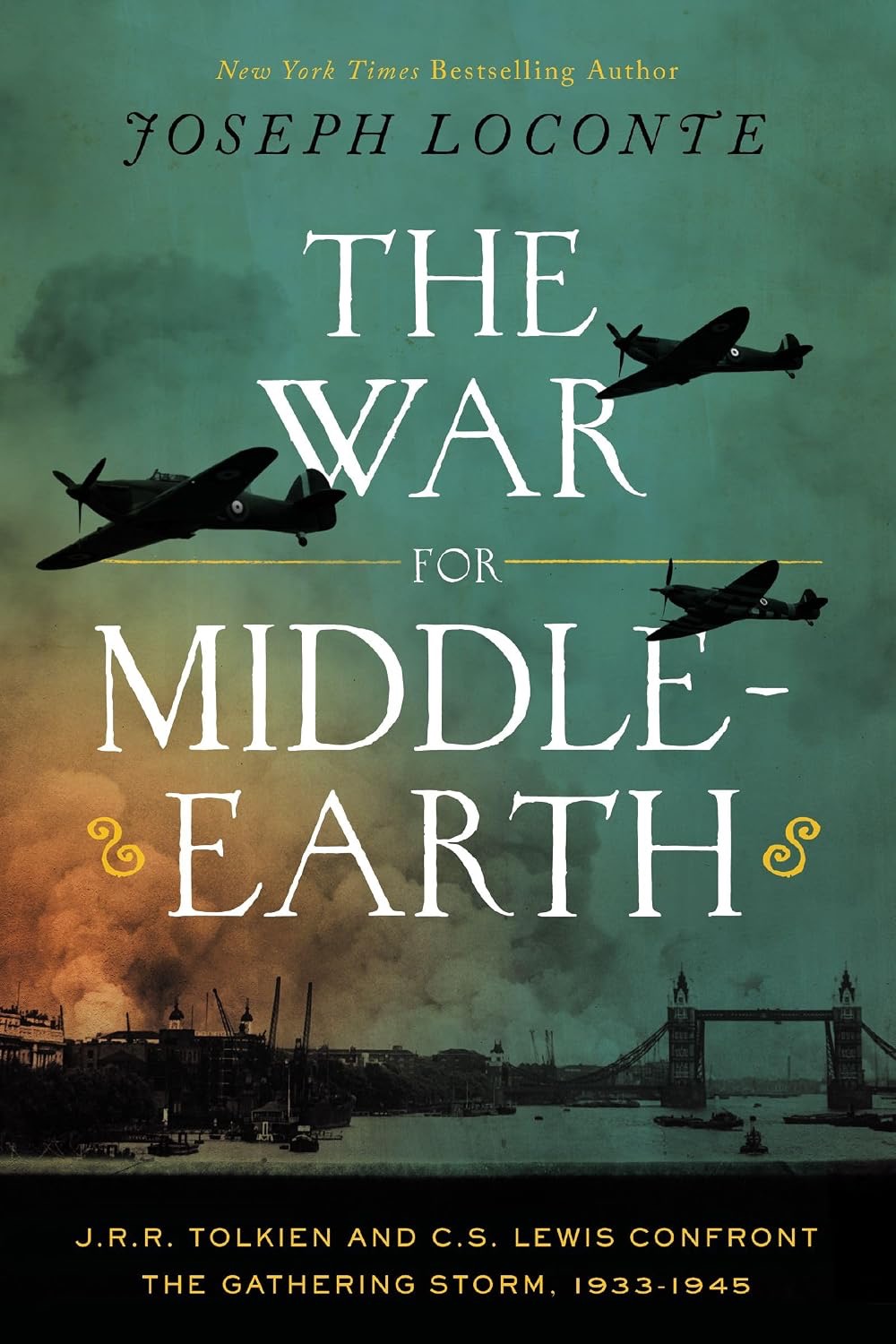
Joseph Loconte’s The War for Middle-earth: J.R.R. Tolkien and C.S. Lewis Confront the Gathering Storm, 1933–1945 belongs firmly in the second category.
It is tempting to think of J.R.R. Tolkien and C.S. Lewis principally as two remarkable writers whose imaginations gave us Middle-earth and Narnia. Loconte asks us to look again.
These were men formed by war, living through an age when Europe was once more moving towards catastrophe. They watched totalitarian movements gather strength, institutions falter, old certainties collapse and ordinary people face choices about courage, loyalty, truth and evil.
And they wrote.
That matters.
Both Lewis and Tolkien were profoundly shaped by their experiences of the First World War. The trenches and the carnage they witnessed became part of the world from which The Lord of the Rings and The Chronicles of Narnia would eventually emerge. They knew that war was not an abstraction. They had seen what industrialised violence could do to human beings.
Then, in the 1930s, they watched forces gathering that would bring Europe and the world into war again.
They wrote, spoke and warned in the shadow of that gathering storm.
Loconte’s achievement is to place their friendship and their writing back into that world.
Suddenly Mordor looks rather less remote.
Power and the people who wield it
The great struggle in Tolkien is not simply between armies. It is about what power does to those who possess it—or desire it. The Ring promises the ability to accomplish good by acquiring sufficient power. Yet the very instrument that appears capable of defeating evil corrupts those who seek to wield it.
That is not merely fantasy. It is a question every leader should understand.
What happens to us when we acquire power?
Leaders know what is at stake when the struggle becomes about power: who will have it and who will not. They must understand both the responsibility that comes with power and the risks that accompany its possession.
And perhaps there is a harder question:
What happens when we convince ourselves that our purposes are good enough to justify how we use it?
Those questions were urgent in the 1930s. They have not become less urgent since.
My own journey with Jesus began in the military. The twelve years that followed were intense years of learning about war at the United States Naval Academy, training for war in the Marine Corps, and going to war in Vietnam.
Those experiences gave me a particular perspective on leadership.
Leaders must remain focused on the mission without ever losing sight of the people they lead. They often see things others do not, and that means understanding what may be at stake in the decisions they make—or choose not to make.
One lesson has stayed with me: leadership often looks quite different from the inside.
From a distance we see rank, position and authority. Up close, leadership is frequently a succession of decisions made with incomplete information, competing obligations and consequences that cannot always be known in advance.
That is one reason Tolkien and Lewis still speak so powerfully.
Their heroes are rarely invulnerable.
They are frightened. They become tired. They doubt themselves. They depend upon friendship—upon relationship. They make mistakes. And sometimes the person upon whom history turns is not the obvious leader at all.
There is something deeply Christian in that dependence upon relationship.
Jesus modelled it in His relationships with Peter, James and John. When He sent His followers out, He sent them two by two. He knew the battle into which He was sending them. He did not intend them to face it alone.
That should interest anyone who thinks seriously about leadership.
“But so does the person you become while pursuing it.”
Courage without illusion
There is another quality running through Loconte’s account that deserves attention: neither Tolkien nor Lewis was sentimental about evil.
They understood that evil exists and that there are times when it must be resisted.
But neither man allowed the existence of an enemy to excuse the corruption of the person opposing him.
That distinction is easily lost.
Military people understand something about this. Discipline is not simply the ability to fight. It is knowing why you fight, whom you are protecting, what you will do—and what you will refuse to become in doing it.
The same principle applies beyond the battlefield.
Political leaders face it. Business leaders face it. Parents face it. Anyone entrusted with authority eventually faces it.
And we should think carefully about what we mean by victory.
The Cross was a victory, although to those who stood beneath it that day it could hardly have looked like one.
That should make Christians particularly careful about assuming that victory can always be measured by immediate success, possession or power.
Victory matters.
But so does the person you become while pursuing it.
The importance of friendship
Loconte also reminds us that Tolkien and Lewis did not do their thinking alone.
The Inklings met, talked, argued, read unfinished work aloud, questioned one another and shared life together.
That is enormously important.
For many years I have been involved with the National Prayer Breakfast movement and its international expression. Much of what I have valued most in those years has not happened from the platform. It has happened around a table, in a quiet conversation, or when somebody has asked a question that caused the rest of us to think again.
The great things did not come from the head table. They came from the breakfast tables.
That distinction matters.
Leaders need people around them who are prepared to ask difficult questions.
Not every disagreement is disloyalty.
Not every friend who tells us we are wrong is an opponent.
And not everyone who tells us what we want to hear is a friend.
Lewis and Tolkien sharpened one another. Their friendship reminds us that serious ideas are often forged in conversation before they find their way into speeches, policies—or stories.
Relationships help us forge the ideas that matter.
When the storm gathers
The phrase in Loconte’s subtitle that stays with me is “the gathering storm.”
People living through history rarely know what chapter they are in.
In 1933, nobody could pick up a history book and turn to the final page to discover how events would end. Decisions had to be made without that luxury.
The same is true today.
We live with war again in Europe, conflict and uncertainty across the Middle East, renewed competition between major powers, extraordinary technological change and a growing argument about what kind of societies we want to be.
We should be careful about easy historical comparisons. Our time is not the 1930s.
But human nature has not changed nearly as much as our technology has.
As a Christian, I believe there is a spiritual reality behind human conflict as well. Jesus described the enemy’s purpose in stark terms: to “steal and kill and destroy.” That agenda has not changed either.
Power still tempts.
Fear still distorts judgment.
Crowds can still be persuaded.
Institutions can still fail.
Good people can still remain silent for too long.
And courage still matters.
That is why The War for Middle-earth is worth reading now.
Not because Tolkien and Lewis provide a handbook for geopolitics. They do something more useful.
They make us think about the kind of people we must become if we are to meet difficult times without being remade by them.
For the leader, perhaps that is the question beneath all the others.
We spend a great deal of time asking what should be done.
Tolkien and Lewis invite another question first:
Who must we be when the time comes to do it?