Edition I · The Principal Long Read
The Atlantic Archipelago
A Strategic Compact for an Unsettled Age
By Mark J. Finlay FRICS · Edition I · 24 September 2026
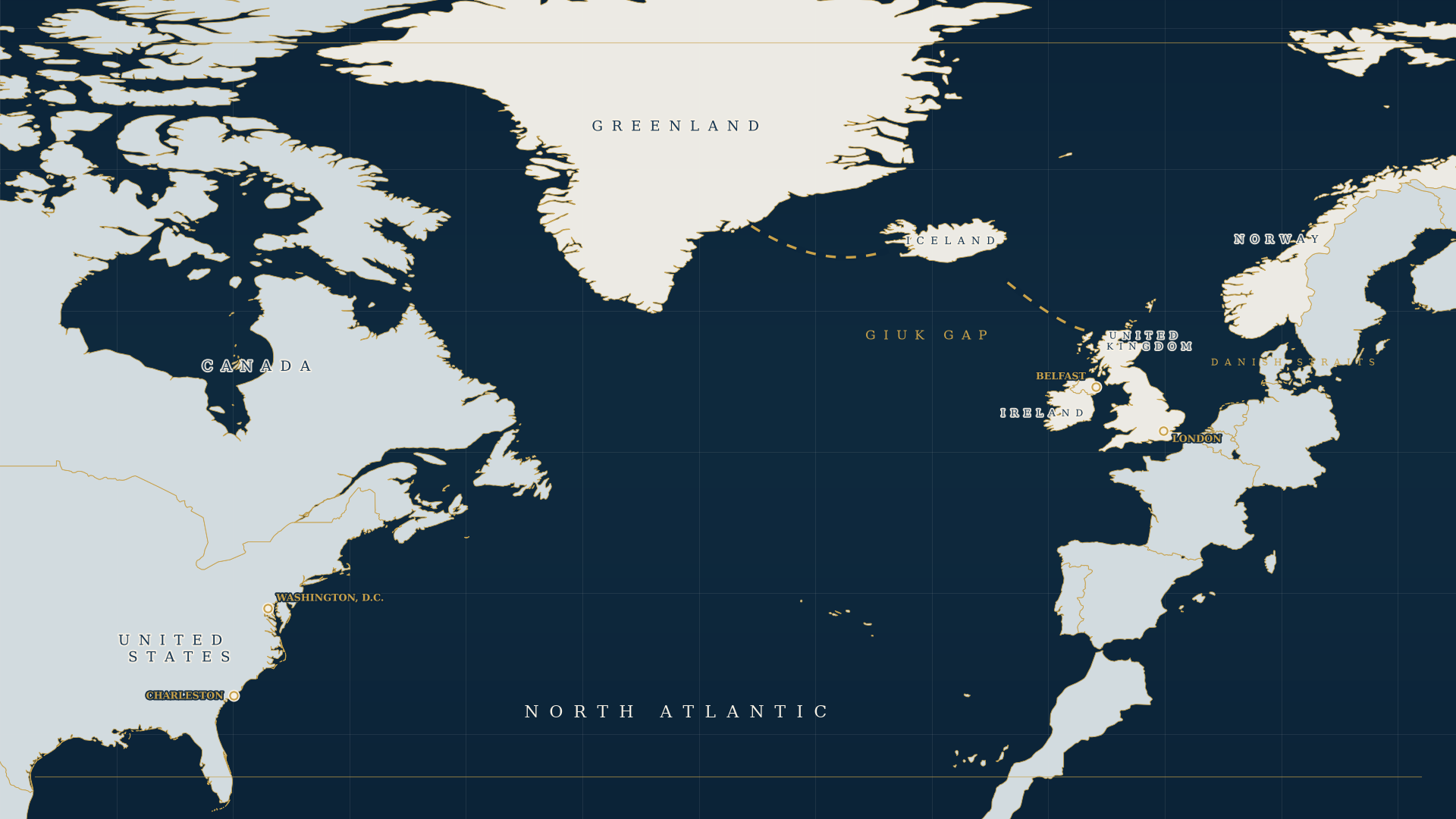
The constitutional future of the British Isles is again being contested. Their strategic geography is not.
Change elsewhere has always caused people to reconsider arrangements closer to home. During the Atlantic revolutionary age, ideas crossed borders and oceans almost as readily as armies and merchant ships. The American Revolution influenced France; France helped ignite Haiti; and the repercussions spread into Ireland, Europe and Latin America. Political movements learn from one another—and moments of upheaval give old ambitions new confidence.
That does not mean constitutional change across these islands is inevitable, or even desired by most of their people. Many remain content with the constitutional settlement while being deeply dissatisfied with the state of government, public services or society. Those are not the same thing. But the renewed coordination among nationalist parties in Scotland, Wales and Northern Ireland shows that constitutional arguments once treated separately are increasingly being presented as part of a common cause.
Whatever becomes of that cause, the strategic facts will remain. These islands still guard the approaches between continental Europe, the Arctic and North America. They still sit across the maritime routes through which trade, energy, data, military power—and danger—must pass.
Yet geography and responsibility have not been equally matched. Ireland illustrates the larger problem. It occupies a strategically important Atlantic position while maintaining military neutrality and comparatively limited maritime and air-surveillance capacity. That is a legitimate sovereign choice, but it does not remove the security requirements created by geography. We return to that question below.
It is against this strategic background that the renewed constitutional pressure—and the attempt to coordinate it across national boundaries—must be understood. In Cardiff on 14 September, the leaders of Plaid Cymru, the Scottish National Party and Sinn Féin gathered to affirm the right of Wales, Scotland and Northern Ireland to seek constitutional change.
Michelle O’Neill attended amid a dispute over whether she did so as Sinn Féin vice-president or as Northern Ireland’s First Minister. The distinction was convenient, but it was not trivial: Northern Ireland’s Executive rests on a joint office, and one holder cannot turn a party declaration into settled government policy.
The summit followed President Donald Trump’s remarks in Ireland in favour of Irish unity. His words pleased republicans, irritated unionists and drew attention once again to the consent provisions of the Belfast Agreement. They also revealed a larger truth. Questions once treated as settled—where sovereignty lies, which institutions command loyalty and how the nations around the North Atlantic relate to one another—are again open to argument.
We should not answer those questions with nostalgia. Nor should we pretend that constitutional disruption would leave defence, trade and infrastructure untouched. A Scottish vote for independence, a border poll on the island of Ireland or a further transfer of power to Cardiff would be decided by the people entitled to decide it. Yet each outcome would alter the political ownership of assets that serve a much wider strategic space.
The right response is neither to suppress constitutional debate nor to wait until a referendum campaign forces hurried answers. It is to build a framework sturdy enough to survive different constitutional outcomes.
I call that framework the Atlantic Archipelago.
Geography has already voted
The Atlantic Archipelago is not a new name for the British Isles, still less an attempt to smuggle one constitutional preference into a geographic label. It describes a connected strategic system: the United States and Canada facing east; Greenland, Iceland and the Faroe Islands across the northern ocean; Great Britain and the island of Ireland at Europe’s Atlantic edge. The nations and territories within it have different constitutions, alliances and identities. The water joins what politics divides.
Long before modern borders, Dál Riata linked north-eastern Ireland with Argyll and the western seaboard of Scotland. It was a maritime kingdom because the sea was a road rather than a wall. People, goods, belief and power moved between coasts. The surviving record is incomplete and should not be pressed into service for a modern political cause, but the underlying lesson remains sound. Communities around these waters have always depended upon movement and mutual support.
Today the cargo is different. Energy, food, manufactured goods and data travel beside naval vessels and fishing fleets. The seabed carries cables on which governments, markets and households depend. Ports act as commercial gateways in peacetime and strategic infrastructure in crisis. An interruption off Ireland, Scotland, Iceland or Greenland can be felt in London, Brussels, Washington and far beyond.
Our institutions, however, divide this connected space into separate files. NATO considers collective defence. The European Union governs much of the trade and regulatory environment. The Joint Expeditionary Force brings together northern European military partners. The British-Irish Council provides a political forum across these islands. The United States and United Kingdom have their Atlantic Declaration and AUKUS. Ireland remains militarily neutral while working with NATO through Partnership for Peace and drawing closer to Britain and other neighbours on maritime security. Each arrangement is useful. None treats the northern Atlantic as a single strategic system in which defence, trade, ports, energy and data meet.
The gap in the map
The Greenland–Iceland–United Kingdom Gap is the clearest place to see the strategic importance of the Atlantic Archipelago. Russian naval power enters the Atlantic from two distinct but connected theatres. The Northern Fleet deploys from bases on the Kola Peninsula through the Barents and Norwegian Seas; while vessels of the Baltic Fleet must pass through the Danish Straits before entering the North Sea. It is understood that the fleets have different bases, capabilities and operating environments, but both answer to the Russian Navy’s central command and may be coordinated in pursuit of the same strategic objectives. NATO’s ability to detect and track their movement—and, in conflict, to deny Russia unfettered access to the Atlantic—helps protect the reinforcement routes connecting North America and Europe.
Geography nevertheless imposes different gateways. The Danish Straits constrain movement from the Baltic, while the GIUK line lies across the principal approaches between the Norwegian Sea and the wider North Atlantic. Pressure in the Arctic, movement through the Norwegian and Barents Seas, activity in the Baltic and the security of the Atlantic sea lanes therefore belong to one strategic picture. They place demands upon the same alliance, industrial base and surveillance network.
These are places Where the World Narrows™. Sometimes the narrowing is physical, as in the Danish Straits, where ships must pass through confined waters between the Baltic and North Sea. Elsewhere it is strategic, as across the GIUK line, where geography concentrates the principal approaches between the Norwegian Sea and the wider Atlantic. In each case, movement becomes more visible, infrastructure more valuable and control more consequential.
The same pattern recurs across the world: at Hormuz, Bab el-Mandeb and Suez; through the Bosporus and Dardanelles; and around the maritime approaches to Taiwan. Geography does not determine every outcome, but it limits the available choices. Power gathers where those choices narrow.
The Atlantic Archipelago is shaped by two such thresholds. That gives the nations and territories around it advantages in trade, intelligence, energy and defence. It also imposes responsibilities that constitutional change cannot dissolve.
Scotland sits near the centre of the northern network. HM Naval Base Clyde at Faslane is home to the core of the Royal Navy’s Submarine Service, including Britain’s nuclear deterrent and its hunter-killer submarines. RAF Lossiemouth houses the United Kingdom’s nine Boeing Poseidon MRA1 maritime-patrol aircraft, equipped for anti-submarine warfare, surveillance and search and rescue, alongside front-line Typhoon squadrons.
Rosyth carries a different but complementary weight. The Queen Elizabeth-class aircraft carriers are home-ported at Portsmouth, but they were assembled at Rosyth, which remains their principal deep-maintenance base. Babcock’s Rosyth facility also supports Royal Navy special projects. I spent almost a decade responsible for development there. The strategic asset is not simply the dock. It is the concentration of engineering judgment, security-cleared skill, supply-chain knowledge and waterside capacity required to build, maintain and sustain a modern fleet.
Scottish independence would not hand the North Atlantic to Russia. An independent Scotland would retain its own interest in secure waters and could seek membership of NATO. Existing allies could negotiate continued access, basing, intelligence and industrial arrangements. None of that, however, would happen by magic. The future of the nuclear deterrent, Faslane, Lossiemouth, Rosyth, intelligence sharing and command arrangements would become subjects of negotiation at precisely the moment when adversaries would be watching for uncertainty.
Ireland creates a different exposure. Military neutrality is a settled part of its political tradition, although it is government policy rather than a constitutional prohibition on security cooperation. The Republic occupies the western approaches to Europe, possesses a vast maritime domain and sits alongside subsea cables upon which much of the transatlantic economy depends. Nevertheless, it has maintained only a limited capacity to monitor, patrol or defend that space.
Ireland may be militarily non-aligned, but the waters and airspace surrounding it are not somehow rendered neutral. In practice, the Republic relies substantially upon capabilities provided by the United Kingdom, the United States and other NATO members for the security of the wider maritime and air approaches from which it benefits.
That dependency is not theoretical. At the end of August 2026, Dublin reportedly requested a Royal Navy warship to provide air-defence cover while European defence ministers met in County Wicklow. Because of the legal and political constraints surrounding Irish neutrality, the vessel was expected to remain beyond Ireland’s territorial waters—even while helping to protect Irish airspace. A French frigate had provided comparable support during earlier meetings connected with Ireland’s Presidency of the European Union. These were sensible acts of cooperation; they were also unusually clear demonstrations of capabilities Ireland does not possess for itself.
Dublin has begun to acknowledge the gap. Its first National Maritime Security Strategy, developing radar programme and planned regeneration of the Naval Service are welcome. But they also expose how long the problem was allowed to persist. Neutrality need not mean passivity; still less should it become a respectable name for allowing neighbouring countries to carry the burden.
The point is not that Ireland must abandon neutrality or that Scotland must remain within the United Kingdom. It is that constitutional choice carries strategic duties. Sovereignty without the means to monitor, protect and sustain the waters surrounding it is sovereignty partly exercised by somebody else. The map may be redrawn. The sea—and the responsibilities imposed by it—will remain.
Ports make strategy real
Too much geopolitical writing ends when the map has been coloured. Real strategy begins at the quayside.
Belfast Harbour handled 24.3 million tonnes of goods in 2025. Its own economic assessment attributes £8.8 billion in regional gross value added to trade through the port, equal to 15.7 per cent of Northern Ireland’s economic output. More than four-fifths of Northern Ireland’s imported petrol, diesel and home-heating oil passes through Belfast. Those figures describe a commercial port, but they also describe food security, energy resilience and the everyday life of a region separated from Great Britain by water and joined to Ireland by land.
Charleston provides the western counterpart. South Carolina Ports handled 2.6 million twenty-foot-equivalent container units in the 2025 financial year, connecting one of America’s fastest-growing manufacturing regions to Atlantic markets. Its marine terminals, inland rail links and distribution network show how a port can reach hundreds of miles beyond its harbour. I have worked with ports on both sides of the ocean, from Belfast to Charleston, and served as a Charleston Port Commissioner. The same lesson recurs: a nation discovers whether its strategy works when ships, trains, cargo, labour and information must move together under pressure.
Belfast and Charleston should therefore be more than illustrations in an essay. They could anchor a working Atlantic ports network, joined by Halifax, Liverpool, the Clyde and Forth systems, Dublin, Cork, Shannon Foynes, Milford Haven, Reykjavík and appropriate Greenlandic ports. The purpose would not be to create another ceremonial association. It would be to match port capability to strategic need.
Such a network could map spare capacity, heavy-lift facilities, repair yards, fuel storage, rail access, customs bottlenecks, cyber exposure and the ability to receive diverted traffic. It could run civil-military logistics exercises without turning every commercial harbour into a naval base. It could identify where private investment serves both trade and resilience. And it could give smaller ports a place in a system often designed around a handful of large hubs.
Ports are the new airfields: fixed assets whose importance grows when distance, disruption and the movement of mass matter again. They are also places where cooperation can begin without waiting for agreement on every constitutional question.
The opportunity extends beyond moving cargo. The United States is again confronting the industrial arithmetic of sea power: it needs more naval and auxiliary vessels than its present shipbuilding base can produce quickly enough. Washington is consequently examining how trusted allied shipyards, designs, investment and manufacturing techniques might augment American capacity while rebuilding the domestic workforce and supply chain.
That creates an obvious Atlantic opportunity. Belfast is again building large naval-support vessels; Rosyth retains specialist naval engineering, integration and deep-dock capability; Canadian and other allied yards bring complementary strengths. American yards should remain at the centre of American naval construction, particularly where classified systems and final integration are concerned. But allied yards could fabricate modules, provide proven designs, relieve selected bottlenecks and transfer manufacturing expertise while investing alongside American partners. The objective would not be to export American shipbuilding. It would be to use allied capacity to accelerate its recovery.
That industrial opportunity sits within a wider reconsideration of the North Atlantic relationship. European Commission President Ursula von der Leyen has proposed opening the door to Canada becoming the European Union’s first “associate member”—a status that does not yet exist and whose precise form would have to be negotiated. Addressing the European Parliament the following day, Prime Minister Mark Carney said Canada welcomed the ambition and argued for much deeper integration in defence production, energy, critical minerals, advanced manufacturing, technology and Arctic security.
Washington’s reaction exposed the risk as well as the opportunity. President Trump called the proposal “laughable” and threatened heavy tariffs on Europe if he concluded that the arrangement was intended as a hostile act against the United States. Carney, for his part, insisted that Canada was seeking resilience rather than another great-power bloc. The distinction matters.
An Atlantic in which Canada, Europe and the United States build competing economic fortresses would weaken the very resilience each says it wants. The greater opportunity is to make their complementary capacity—markets, energy, critical minerals, shipbuilding, technology, capital and defence production—the basis for deeper Atlantic trade and strategic cooperation.
A compact rather than another capital
The Atlantic Archipelago does not need a flag, a parliament or a headquarters with an appetite. It needs a compact for defence, industry and trade: limited in purpose, practical in design and compatible with existing obligations.
Its membership would require care. The United States, Canada, the United Kingdom, Ireland and Iceland are sovereign states. Greenland and the Faroe Islands exercise self-government within the Kingdom of Denmark. Scotland, Wales and Northern Ireland hold devolved powers within the United Kingdom. Any arrangement must respect those distinctions and avoid treating smaller nations as pieces on somebody else’s board. Recent American rhetoric about Greenland and Iceland makes that safeguard especially important. Strategic partnership cannot be built upon jokes about possession.
A workable compact could concentrate on five connected tasks.
First, it could produce a shared maritime picture. Coastal radar, satellite information, sonar, patrol aircraft, naval reporting, port data and private cable-operator intelligence remain divided among institutions with different rules. The compact could establish protocols for exchanging warnings and for bringing neutral Ireland into appropriate maritime awareness without pretending that it has joined NATO.
Second, it could build a ports and logistics plan. Governments and operators would identify which harbours can refuel, repair, store, disperse and reroute; which rail and road links require investment; and where customs rules would slow reinforcement or emergency trade. Regular exercises should include shipping companies, energy operators, unions and local authorities as well as armed forces.
Third, it could protect subsea infrastructure and energy links. Mapping cables is not enough. The partners would need common thresholds for reporting suspicious activity, agreed procedures after a break, repair-vessel availability, cyber standards for landing stations and exercises that test what happens when several systems fail together.
Fourth, it could join industrial policy to security. Shipbuilding, ship repair, autonomous systems, maritime aircraft support, offshore energy and advanced manufacturing depend upon long supply chains and scarce skills. Rosyth’s specialist workforce, Belfast’s engineering tradition, South Carolina’s manufacturing base, Canadian yards and Icelandic and Greenlandic operating knowledge are parts of one capacity problem. Investment rules and procurement should reward trusted supply, redundancy and the ability to surge.
Fifth, it could make lawful movement easier. Trusted-trader programmes, compatible digital customs systems, recognition of professional qualifications and arrangements for specialist workers would strengthen both commerce and emergency response. The Atlantic should become easier to cross for legitimate goods, engineers and investment, and harder to exploit for sabotage, sanctions evasion and organised crime.
For a transactional Washington, the proposition is measurable: more ships delivered, more American shipyard capacity, allied capital invested in the United States, larger orders on both sides of the Atlantic, resilient supply chains, faster movement of goods and a more equitable division of the cost of defending the routes on which all depend.
The proposition must nevertheless be larger than one presidency. A durable compact would rest on treaty obligations, parliamentary consent, commercial contracts and local benefit. It should survive changes of government because the infrastructure it protects will outlast every administration.
Constitutional change without strategic fracture
The hardest test for the Atlantic Archipelago is also the reason to develop it now. Can cooperation survive a change in sovereignty?
The Belfast Agreement gives a clear answer on Irish unity: Northern Ireland remains part of the United Kingdom unless a majority there votes otherwise, and a united Ireland would require consent north and south. That principle should govern public discussion, including commentary from friends abroad. No outside leader can confer legitimacy that the people themselves have not supplied.
But the Agreement contains another principle with implications well beyond a border poll. It recognises the birthright of the people of Northern Ireland to identify and be accepted as Irish or British, or both, and protects their right to hold both British and Irish citizenship irrespective of any future change in Northern Ireland's status.
That is more than a safeguard for one community. It recognises that sovereignty, citizenship and identity need not be identical things.
Brexit offers a warning against assuming that today's constitutional surroundings will remain tomorrow's. The Belfast Agreement was negotiated when both the United Kingdom and Ireland belonged to the European Union. It was not designed around the possibility that one would leave while the other remained. The resulting argument over the border, trade and sovereignty exposed what happens when one part of a constitutional architecture changes while the relationships surrounding it have not been prepared for the change. We should not make the same mistake twice.
The security and constitutional questions should therefore be examined before any border poll, not inserted as a scare during one. What precisely would voters be asked to choose between? What constitutional settlement would stand on the other side of the ballot paper? What would happen to NATO coverage, intelligence arrangements, defence sites, policing cooperation, ports and energy supply? And how would the British identity and citizenship of those who wished to retain them be expressed and protected in practice?
Scotland presents its own list. What basing rights would an independent government grant? Could the nuclear deterrent remain at Faslane during a transition, and on what terms? How quickly could Scotland enter NATO if it chose to apply? How would Rosyth’s Royal Navy work, classified programmes and skilled employment be protected? Who would pay for Lossiemouth’s missions and how would its aircraft contribute to a shared operating picture? Assertions that everything would continue, or that everything would collapse, are equally inadequate.
Wales has fewer assets at the centre of the GIUK system, but its ports, energy facilities and position on the western and southern approaches matter. Any serious constitutional project must account for them.
The compact could provide continuity clauses under which practical cooperation survives constitutional transition, subject to democratic approval. It would not decide the Union’s future. It would reduce the risk that a political divorce becomes a strategic vacancy.
The price of a useful idea
There are obvious objections. Ireland will resist any structure that looks like NATO membership by the back door. Scotland’s nationalists will reject an arrangement designed to preserve Westminster control. Canada, Greenland and Iceland will bristle if an American-led project treats them as a defensive perimeter. Existing institutions will ask why another forum is needed. Treasuries will prefer communiqués to concrete.
Those objections should shape the design. Participation can vary by task. A neutral state can share cable warnings and conduct rescue exercises without accepting a collective-defence guarantee. Devolved administrations and port authorities can join commercial and infrastructure work while defence remains with sovereign governments. NATO should retain military command; the European Union should retain its legal powers; the Belfast Agreement should retain its constitutional authority. The compact’s value would lie in the seams between them.
It will also cost money. Maritime patrol, dock capacity, cable repair, port resilience and trained people cannot be summoned after a crisis begins. But the choice is not between expenditure and no expenditure. It is between planned investment in assets that also support trade, and emergency spending after a hostile act or infrastructure failure has already imposed its price.
Where the ocean leads
The Cardiff declaration and President Trump’s Irish remarks may prove fleeting events. The forces beneath them are not. National identity has returned to the centre of politics. Trust in post-war institutions has thinned. Russia contests the seas, the seabed and the information space. The United States wants allies to carry more weight. Britain has left the European Union, while the Union itself faces pressure to expand eastward and reform how it works.
In that setting, defending the constitutional status quo is not a strategy. Neither is breaking states apart and hoping cooperation will reassemble itself afterwards.
The Atlantic Archipelago begins with a harder, more useful premise. The peoples around the northern Atlantic may choose different political futures, but they will continue to share waters, infrastructure, trade routes and threats. The task is to convert that permanent geography into dependable cooperation.
We need not rebuild an empire or invent another union. We need to set a table at which sovereign governments, devolved nations, ports, armed forces and industry can deal with the facts the ocean has placed before them.
As I said in my Sarajevo Security Conference address, “Peace is never permanent. Nor is conflict inevitable. Both are built.” In the North Atlantic, the building blocks are already in view.
“The water joins what politics divides.”